
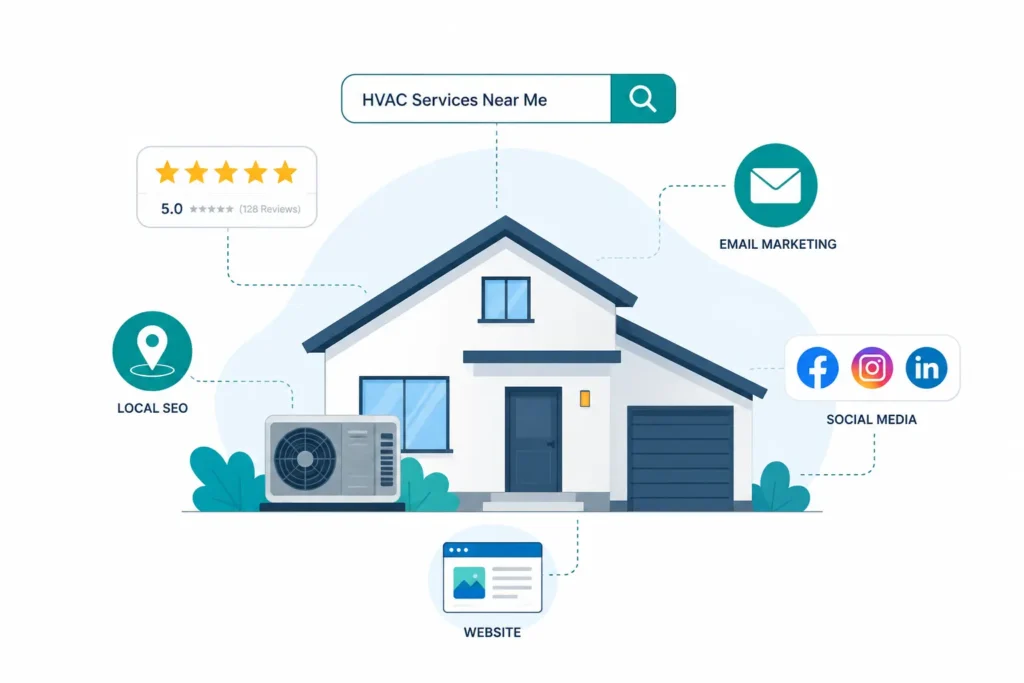
HVAC digital marketing is the use of online channels — local SEO, Google Ads, Local Services Ads, website optimization, social media, email marketing, reputation management, and content marketing — to attract leads and book service calls for heating, air conditioning, and ventilation companies. The goal is to put your business in front of homeowners and commercial clients the moment they search for HVAC services, and make it easy for them to choose you over every competitor within reach.
This guide maps every major channel, what each one actually costs, what it returns, and the order most contractors should tackle them in. It also helps you decide whether to handle your marketing in house, hire specialist help, or find the right balance of both. It’s written for company owners and marketing managers who want a clear eyed picture of the landscape — not a sales pitch for any single tactic.
Eight channels have dedicated deep dive guides linked throughout. This article is the strategic hub — the place you come to understand how everything connects before you go deeper on any one piece.
Why Digital Marketing Has Become Unavoidable for HVAC Companies
How Homeowners Actually Find HVAC Companies Now
The decision about which HVAC company to call is almost always made before anyone picks up the phone. Research consistently shows that more than 90% of homeowners look up local service businesses online before making contact — they search, read reviews, check websites, and only then dial. The phone call is no longer the beginning of the sales process. It’s the conclusion of one that started on Google.
This shift happened gradually and then all at once. The contractors who recognized it early and built their online presence accordingly now have more work than they can handle. The ones who didn’t are competing on price for whatever leads happen to find them.
The Market Reality in 2025–2026
More than 120,000 HVAC businesses operate in the U.S. inside a market worth over $35 billion annually. The barrier to entry is genuinely low — a licensed technician with a van, a Google Business Profile, and a few good reviews can look credible online from day one. That’s what makes digital presence so critical: the differentiation between a three truck operation and a 30 truck operation is nearly invisible to a homeowner doing a Google search, unless the smaller company has built that presence carefully.
The companies consistently capturing the most leads in any given market aren’t always the most technically skilled or the longest established. They’re the ones that show up first, look trustworthy, and have the review volume to confirm they’re a safe choice.
The Real Cost of Staying Invisible Online
When you’re not visible digitally, your competitors capture leads that should be yours. Your trucks run lighter through off-peak months because there’s no pipeline of pre-sold prospects. Customers you’ve served for years hire someone else when they need their next repair not because they’re disloyal, but because the other company showed up in their search and you didn’t.
Being technically excellent gets you repeat customers and referrals. Being digitally visible gets you the first call. You need both, but digital visibility is no longer something you can defer.
The 8 Core HVAC Marketing Channels Compared at a Glance
Every channel in HVAC marketing serves a different job. Some build visibility slowly and pay off for years — local SEO, content, reputation management. Others generate calls this week at a predictable cost per lead — Local Services Ads and Google Search Ads. The mistake most contractors make is treating these channels as interchangeable, picking whichever one a vendor is currently selling them.
The table below gives you an honest side-by-side comparison. Use it to understand what each channel is actually for, what it costs in the real world, and which stage of business it makes sense to prioritize.
Channel Comparison Table:
| Channel | Primary Goal | Time to Results | Avg Monthly Cost | Best For |
|---|---|---|---|---|
| Local SEO | Google Maps (Local Pack) visibility | 3–6 months | $500–$2,000 | Every HVAC company |
| Google Ads (Search) | Paid high intent leads | Days | $1,000–$5,000+ | Growth and scale stage |
| Local Services Ads | Pay-per-lead | Days to weeks | $300–$1,000 | Beginners and growth |
| Website Design / CRO | Convert traffic to calls | Ongoing | $150–$500/mo maintenance | Every stage |
| Social Media | Brand trust, local presence | 1–3 months | $300–$800 | Residential focus |
| Email Marketing | Retention and upsells | Weeks | $200–$500 | Established companies |
| Reputation Management | Reviews and conversion trust | 1–2 months | $100–$300 | Every stage |
| Content Marketing | Organic search traffic | 4–8 months | $500–$2,000 | Growth and scale |
Which Channels to Prioritize First A Practical Framework
Under $500K in annual revenue: Two channels to start. Optimize your Google Business Profile (free, highest ROI per hour invested) and activate Local Services Ads (pay per lead, no wasted spend). Everything else can wait.
$500K to $2M: Your foundation should be set. Layer in local SEO for compounding organic visibility and Google Search Ads for more targeted paid reach. Reputation management and email marketing for your existing customer base belong here too.
$2M and above: The full stack starts making sense content marketing, social media, advanced PPC, and a systematic approach to email automation. At this stage you’re building brand equity that compounds across every channel simultaneously.
HVAC Local SEO Getting Found in Your Service Area
Why Local SEO Is the First Domino
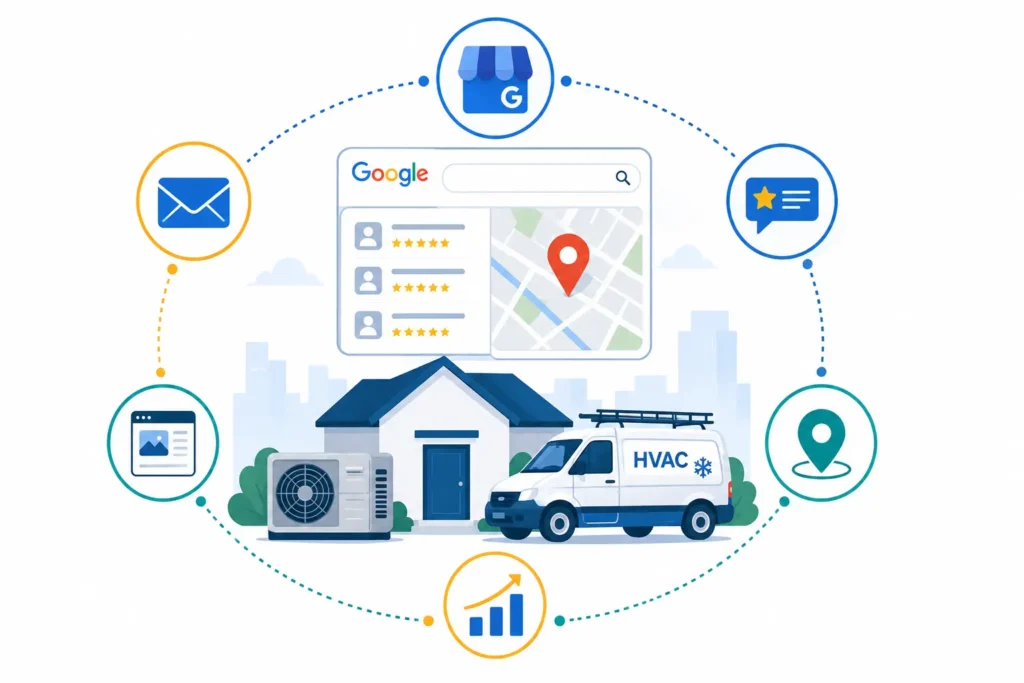
Local SEO is how your business appears when someone nearby searches “AC repair” or “furnace installation” on Google. The concept is straightforward, but the execution has enough nuance to determine whether you appear in the Local Pack those top three map results that capture the majority of local clicks or whether you’re buried on page two.
Nearly half of all Google searches include local intent. In HVAC, where geography is the entire business model, that percentage is even higher. Getting this right isn’t optional; it’s the foundation everything else is built on.
What Drives Local SEO Rankings for HVAC Companies
- Google Business Profile completeness and engagement your primary category, services listed with real descriptions, recent photos, active Q&A, and responses to every review.
- Citation consistency your business name, address, and phone number must match exactly across every directory where you’re listed. Tools like BrightLocal and Whitespark help audit and fix these at scale.
- Service area landing pages individual pages for each city and neighbourhood you serve, not one generic “areas served” page.
- Review velocity a steady, ongoing flow of recent Google reviews carries more weight than a one-time push from two years ago.
The Fastest Free Win: Your Google Business Profile
Google’s own data shows that businesses with complete GBPs are significantly more likely to attract calls and visits. The five fields that move the needle most: your primary category (be specific “HVAC contractor” ranks differently than “air conditioning repair service”), your services list with actual descriptions, your response rate to reviews, photo activity in the last 30 days, and accurate service area configuration.
An incomplete or neglected GBP is the single most common and most correctable oversight in HVAC digital marketing and fixing it costs nothing but time.
→ For the full local SEO playbook including citation building, service area page templates, and a step-by-step Google Maps ranking strategy see our complete HVAC Local SEO Guide.
HVAC Website Design Your 24/7 Lead Generation Machine
Why Most HVAC Websites Don’t Convert
More than half of mobile users leave a site that takes over three seconds to load. Given that more than 60% of HVAC searches happen on mobile devices, a slow website is actively sending leads to competitors — not just underperforming, but doing damage. Add in the absence of a visible phone number, no clear emergency messaging, and generic copy that could apply to any contractor in any city, and you have a website that is technically functional and practically useless.
Your website is where every other marketing channel sends traffic. If it doesn’t convert visitors into callers, nothing else in your strategy performs as it should.
A well-optimised HVAC website typically converts 8–12% of visitors into calls or form submissions. The industry average sits at 2–5%. The gap between those two numbers is largely explained by the five elements below.
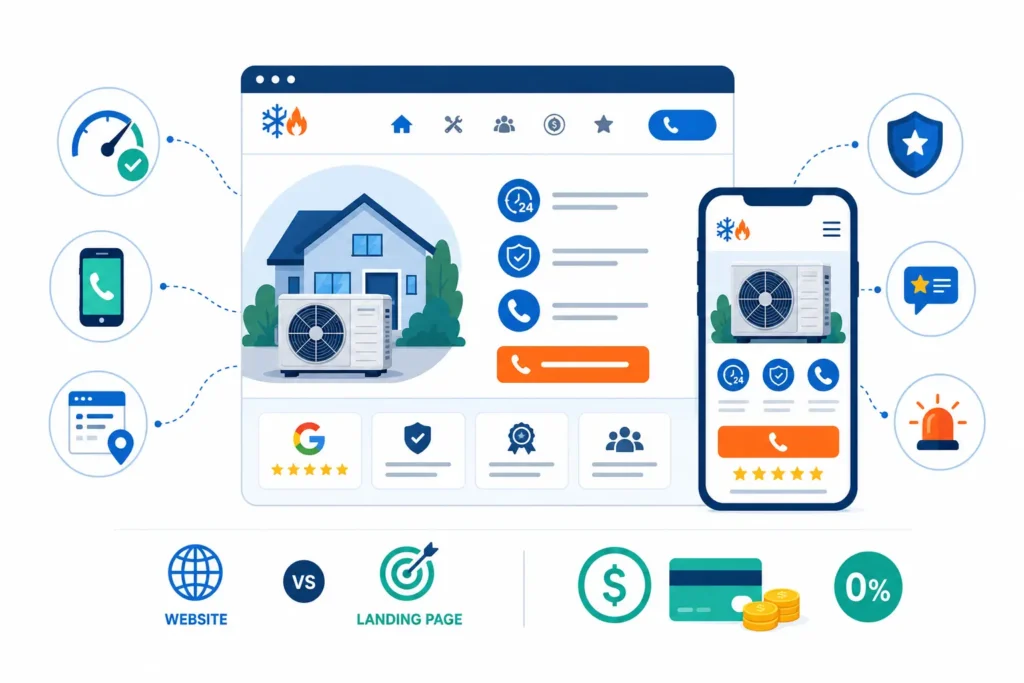
What Separates High-Converting HVAC Websites
- Mobile load time under 3 seconds test yours right now at PageSpeed Insights; if it fails, fixing it is your first priority.
- Click-to-call above the fold on every page on mobile, your phone number should be tappable without scrolling.
- Dedicated pages for each service and each location one page per service, one page per city; not a single combined “services” page.
- Trust signals that aren’t generic your actual Google rating (not just a star image), your license number, manufacturer certifications, and how long you’ve been operating in this specific market.
- Emergency service visibility if you offer 24/7 service, that should be the first thing someone sees; homeowners with a broken system at 11pm are not going to scroll to find it.
How Landing Pages Differ from Your Main Website and Why It Matters
Your website is built to rank for many keywords across many pages — it’s a long-term organic asset. Landing pages are single-purpose conversion tools built for paid campaigns, with one message and one call-to-action. Running Google Ads that drop traffic onto your homepage wastes a significant portion of every dollar you spend. This distinction explains more “why aren’t my ads working” situations than almost any other factor.
Consider also adding financing information to your website. HVAC equipment is a high-ticket purchase a new system often costs $5,000–$15,000. Prominently displaying financing options (“0% interest for 18 months”) reduces the decision friction that kills replacement jobs at the last moment.
→ For conversion rate benchmarks, HVAC-specific page templates, and a speed optimization checklist, see our complete HVAC Website Design Guide.
HVAC Google Ads and PPC Leads for Searches That Are Ready to Convert
LSA vs. Google Search Ads: The Honest Answer
Start with Local Services Ads. LSA is a pay-per-lead model you pay $20–$50 only when a homeowner contacts you directly through the ad. Google’s “Google Guaranteed” badge on LSA listings signals credibility to homeowners before they even click, and the ads convert at 30–45% for many HVAC companies. For contractors who don’t yet have sophisticated conversion tracking in place, it’s the safer and often higher-ROI entry into paid search.
Google Search Ads give you more control: you choose your keywords, set your bids, and can get very specific about geography and timing. But they require more setup, active management, and a tracking infrastructure that connects ad spend to actual booked jobs — otherwise you’re managing spend without managing outcomes. The answer for most contractors: LSA first, Search Ads second, run both simultaneously once the tracking is working.
Numbers to Know Before You Spend Anything
- Average CPC for HVAC keywords: $29–$33, with spikes of 40–60% during peak season
- Average cost per lead via paid search: $115–$153
- LSA cost per lead: $20–$50, with higher purchase intent than most Search Ad clicks
- Highest-cost single keywords: “emergency AC repair”, “HVAC installation”, “furnace replacement” — often $35–$60+ CPC in competitive markets
- Target benchmark: your LTV:CAC ratio should be 3:1 or better; with an average HVAC customer worth $15,340 over their lifetime, acquiring one for $200 is a favorable trade
The Tracking Gap That Kills HVAC Ad Campaigns
The single most expensive mistake in HVAC paid advertising isn’t choosing the wrong keywords or setting the wrong bids. It’s running campaigns without the ability to trace a booked job back to the specific keyword and campaign that generated the call. Without that connection, every budget decision is a guess. CallRail solves this at the call level; ServiceTitan and Jobber connect those calls to actual booked revenue. Both layers are essential at any meaningful PPC budget.
→ For full campaign structure, keyword lists, bidding strategy, and a seasonal HVAC PPC calendar, see our complete HVAC Google Ads and PPC Guide.
HVAC Reputation Management Reviews That Convert Before the Call
What Reviews Are Actually Doing for Your Revenue
A homeowner’s air conditioner fails at 10pm on a Thursday in July. They open Google Maps, search for AC repair, and see two options: one company with 214 reviews and a 4.8-star average, another with 11 reviews and a 4.1. They call the first one. They’re not reading individual reviews — they’re using volume and rating as a proxy for trustworthiness, and they’re making that decision in under 30 seconds.
Reviews also directly affect where you appear in local results. Google weighs review velocity — how recently reviews are coming in — alongside volume. A competitor generating 10 reviews a month will consistently outrank one with the same total count accumulated over three years.
The Three Platforms Worth Focusing On
- Google — carries the highest weight for Local Pack rankings and is the first thing a prospect sees; direct 70% of your review efforts here
- Yelp — attracts actively-comparing buyers; worth maintaining, especially in markets where Yelp retains search visibility for HVAC queries
- Angi and HomeAdvisor — capture early-funnel comparison shoppers; helpful for volume but lower purchase intent than Google
A Review System You Can Start Without Any Software
Three steps that work: Ask within 24 hours of completing a job — that’s when satisfaction is highest and the experience is freshest. Use SMS, not email. Text open rates sit above 90%; email open rates rarely clear 25% in home services. Make the ask personal — a text from the technician who did the work converts at two to three times the rate of an automated message from a company account. Train your techs on those three steps and you have a review generation system that costs nothing to operate.For the complete five-step ask system, CRM automation setup, and seasonal review calendar, see the HVAC review strategy guide.
→ For review request templates, negative review response scripts, and a platform-by-platform reputation strategy, see our complete HVAC Reputation Management Guide.
HVAC Social Media Marketing Trust Before the First Call
What Social Media Is Actually Good For in HVAC
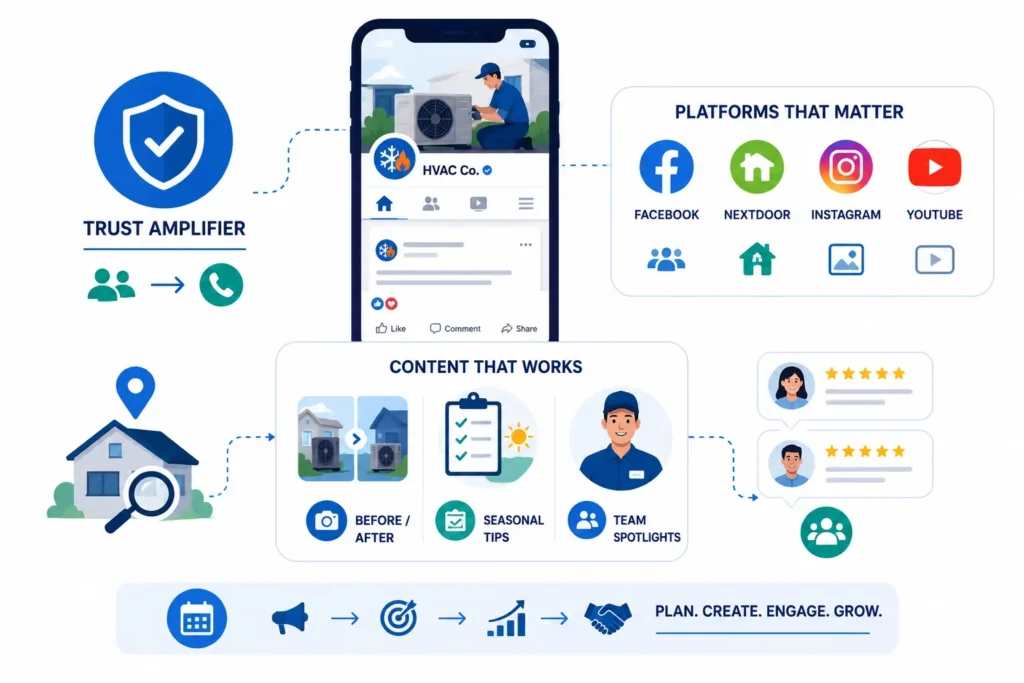
Most HVAC companies either over-invest in social media expecting it to generate leads like Google Ads, or ignore it entirely because it never delivered the calls they hoped for. Both responses miss what social media does well: it functions as a trust amplifier for people who found you somewhere else.
A homeowner discovers your company on Google Maps. Before calling, they check your Facebook page. If it’s active recent photos, real customer interactions, some community involvement it confirms their instinct that you’re a real, trustworthy local business. If it’s empty or three years out of date, it introduces doubt. Social media for HVAC is rarely where the lead originates. It’s where leads go to confirm they’re making the right choice.
Which Platforms Are Worth Your Time
- Facebook the highest-value platform for residential HVAC by a significant margin; the 35–65-year-old homeowner demographic is here, local neighborhood groups are active, and ad targeting for home services is strong
- Nextdoor underused and underrated; neighbor recommendations on Nextdoor carry more conversion weight than almost any other referral type because the trust is built into the platform’s structure. Nextdoor’s Neighbourhood Sponsor program also gives HVAC companies a low-cost way to maintain a local brand presence.
- Instagram works well for visual before/after content; attracts a slightly younger demographic and higher-end residential clients
- YouTube the only platform that actively supports your SEO; maintenance how-to videos and troubleshooting guides rank in regular Google search results and do double duty as both a lead source and a trust builder
Three Content Types That Consistently Work for HVAC
- Before/after photos — installation quality, equipment transformations, and clean workmanship shots perform consistently well and require no writing
- Seasonal tip posts — “Three things to check on your AC before the summer heat arrives” positions you as the helpful local expert and generates neighborhood shares
- Team spotlights — a photo of a technician with a brief bio humanizes the company and reduces the stranger-in-my-home anxiety that affects every service business
→ For a full content calendar, Facebook Ads strategy, and Nextdoor marketing playbook, see our complete HVAC Social Media Marketing Guide.
HVAC Email Marketing The Revenue Channel Hiding in Your Customer List
The Asset Most HVAC Companies Don’t Realize They Have
One HVAC company with 5,000 past customers sent a single pre-season maintenance email in February. The subject line was plain. The offer was simple schedule a spring tune-up before the rush. Within 30 days: $300,000 in booked appointments. Total cost: under $500 in email platform fees. The list had been sitting unused for years.
This kind of result isn’t unusual. It’s what happens when you treat your customer database — built from years of job tickets as a marketing asset rather than a contact archive. The average HVAC customer generates $15,340 in total revenue over their lifetime through service calls, equipment upgrades, and referrals. Keeping that customer costs a fraction of what acquiring a new one does. Email is the most direct, lowest-cost mechanism for doing exactly that.
Four Campaigns Every HVAC Company Should Be Running
- Pre-season maintenance reminder — sent in February for cooling season, September for heating; highest open rates of the year because the timing matches what the customer is already thinking about
- Post-service follow-up and review request — sent within 24 hours of a completed job; handles retention and reputation in one send, and ties directly into your review generation system
- Maintenance plan upsell — sent to customers without an active agreement 30–60 days after their most recent service call, when satisfaction is still high
- Equipment aging outreach — sent to customers whose systems are 10–15 years old; the highest-value conversion email in HVAC because you’re reaching people right when replacement is becoming a real consideration
The Follow-Up Gap That Loses Contracts
Most HVAC contractors follow up with a lead once — maybe twice — then stop. Research on service industry sales has been consistent for decades: the majority of closed sales required five or more touchpoints. Email automation closes this gap permanently. Once a five-email nurture sequence is built, it runs for every lead indefinitely, at zero incremental cost per contact. The contractors who have built this infrastructure convert a meaningfully higher percentage of the same lead volume.
→ For automation workflows, seasonal email templates, and list-building strategies, see our complete HVAC Email Marketing Guide.
HVAC Content Marketing The Long Game That Compounds
Why Content Works Differently for HVAC Than Other Industries
HVAC content does three things simultaneously. It drives organic search traffic (SEO). It builds trust with people who find it (conversion). And it pre-qualifies leads by educating them before they call — which means the homeowner who read your guide on “why a heat pump might replace your gas furnace” comes into the conversation already informed, already trusting your expertise, and already more likely to say yes.
The content type with the highest immediate conversion value in HVAC is diagnostic content — articles that answer the question a homeowner is Googling in the middle of a problem. “Furnace blowing cold air.” “AC not cooling below 75 degrees.” “Why does my heat pump ice up in winter.” These searches happen right before someone picks up the phone, which means ranking for them puts you in front of a prospect at peak purchase intent.
The Four Content Types That Generate HVAC Leads
- Troubleshooting and diagnostic guides — the highest conversion intent of any content type; reaches people mid-problem, right before they call
- Service comparison articles — “heat pump vs. central air vs. mini-split” and “SEER ratings explained” capture decision-stage buyers evaluating options, and build authority around the product categories you sell
- City-specific service pages — rank for “[service] in [city]” searches and are the workhorses of local organic traffic
- Seasonal maintenance guides — establish topical authority and drive pre-season service bookings from existing customers who find them through search
Contractors who build a proper hub-and-spoke content structure around their core services consistently achieve 25–45% higher organic search visibility than competitors publishing random blog posts on no particular schedule.
YouTube: The SEO Channel Most HVAC Companies Leave Completely Empty
YouTube is the world’s second-largest search engine, and HVAC companies that post useful video content — maintenance walkthroughs, troubleshooting guides, installation showcases — get dual benefit: rankings on YouTube itself, and video results that surface in standard Google searches. Video content also converts at 20–35% higher rates than written-only content. The homeowner who watched your technician explain a common AC problem on YouTube trusts you before the first call in a way that a blog post alone rarely achieves.
→ For topic cluster strategy, content calendar templates, and YouTube optimization for HVAC, see our complete HVAC Content Marketing Guide.
The HVAC Marketing Calendar The Strategy Most Contractors Get Backwards
The Timing Problem Nobody Talks About
Here is a pattern that plays out in virtually every HVAC market, every year: business slows down, a contractor decides it’s time to start marketing, they call an agency or start publishing content — and by the time any of it ranks or produces volume, the season they needed it for is over. The SEO content published in May ranks in October. The PPC campaign launched in December produces results in February.
Marketing is infrastructure, not a fire extinguisher. Content needs three to six months before it ranks consistently. PPC campaigns need two to four weeks to exit learning mode and optimize properly. Email lists need to be built before they can be sent to. The companies with full appointment books in peak season didn’t start marketing when the phones got busy — they started six months earlier.
Publish your summer content in January. Publish your winter content in August. This single calendar adjustment, consistently followed, is what separates contractors who scramble for peak-season leads from the ones who have a waitlist.
The Quarterly Marketing Calendar
Q1 (January–March) — Cooling season prep Focus: Publish AC content now so it ranks by June. Send maintenance plan emails to your existing customer list. Begin increasing PPC budget gradually as spring approaches. Top channels: Content, Email, LSA
Q2 (April–June) — Cooling peak, all hands Focus: Maximum ad spend on cooling keywords. Emergency AC pages front and center. Push Google Business Profile posts weekly with seasonal messaging. Top channels: Google Ads, LSA, GBP
Q3 (July–September) — Heating season setup Focus: Publish furnace, heat pump, and indoor air quality content. Seed heating campaigns in September before temperatures drop. Top channels: Content, SEO, PPC
Q4 (October–December) — Heating peak plus retention Focus: Emergency heating campaigns. Year-end review push. Maintenance agreement upsells via email to customers who haven’t converted. Top channels: LSA, Email, Reputation Management
Year-Round Services That Smooth Out the Feast-or-Famine Cycle
The contractors who run consistently full schedules across all 12 months have deliberately built their service mix to include demand that doesn’t depend on temperature extremes. Indoor air quality systems, duct cleaning, annual maintenance agreements, commercial HVAC service contracts, and new construction installations all generate year-round revenue. Actively marketing these services not just performing them when customers ask changes the fundamental shape of the business from seasonal to stable.
Maintenance agreements deserve special attention. A customer on a bi-annual maintenance plan is guaranteed revenue, a guaranteed review opportunity twice per year, and the most likely source of equipment replacement referrals. Marketing toward agreement signups in the off-season is the single highest-leverage quiet-period strategy available to most HVAC companies.
HVAC Marketing Budget How Much to Spend, and Where
The Benchmark: 7–10% of Revenue
The consistent industry guidance for HVAC marketing spend is 7–10% of annual gross revenue. In practical terms: a company doing $1 million annually should budget $70,000–$100,000 per year $5,800–$8,300 per month across all channels. Companies targeting aggressive growth often invest 10–15% to accelerate market share. Those in maintenance mode with strong organic rankings can hold at 5–7% without ceding ground.
Where most contractors go wrong is treating these as fixed allocations rather than dynamic ones. Your spend on Google Ads in June should not match your spend in January. Your content investment in Q1 should serve Q2. A static monthly budget across all channels regardless of season is one of the most common structural inefficiencies in HVAC marketing.
Cost and ROI by Channel
| Channel | Avg Monthly Cost | Cost Per Lead | Time to Results | ROI Potential |
|---|---|---|---|---|
| Local SEO | $500–$2,000 | $15–$40 | 3–6 months | Highest |
| Google Ads | $1,000–$5,000+ | $115–$153 | Days | High |
| Local Services Ads | $300–$1,000 | $20–$50 | Days to weeks | Highest |
| Social Media | $300–$800 | Indirect | 1–3 months | Moderate |
| Email Marketing | $200–$500 | $5–$15 | Weeks | Highest |
| Content Marketing | $500–$2,000 | $15–$45 | 4–8 months | High |
| Reputation Management | $100–$300 | Indirect | 1–2 months | High |
What the First 12 Months Actually Look Like
Months 1–2: Foundation. GBP optimization, LSA setup, website audit and fixes. Minimal visible lead impact yet, but essential groundwork that determines how well everything else performs.
Months 3–4: Early signals. Local Pack rankings begin moving. LSA lead volume stabilizes. GBP-attributed calls increase. You can now see which channels are generating actual inquiries.
Months 5–6: Normalization. Organic leads start appearing consistently. You can begin connecting digital activity to booked jobs. Cost per lead by channel becomes measurable and actionable.
Months 7–12: Compounding returns. Organic traffic builds on itself. Email list and review count grow alongside it. ROI becomes real most contractors who stay the course through month six find themselves with a significantly stronger lead pipeline than they had 12 months prior. Setting these expectations before month one isn’t pessimism. It’s what keeps contractors from abandoning a working strategy during the months before it produces visible results.
→ For a full budget calculator, tool stack recommendations, and ROI tracking frameworks, see our complete HVAC Marketing Budget and Tools Guide.
7 HVAC Marketing Mistakes That Quietly Drain Your Budget
These aren’t theoretical cautions. They’re patterns that appear repeatedly in HVAC marketing audits, in failed agency relationships, and in the retrospective accounts of contractors who spent real money on things that didn’t work. Each one is correctable but most are invisible until someone names them.
Mistake 1: Running Ads Without Call Tracking or Conversion Measurement
If you can’t trace a booked job to the keyword and campaign that generated the call, every budget decision you make is a guess. CallRail attributes calls to specific keywords and campaigns. ServiceTitan and Jobber connect those calls to actual booked revenue. Without at least one layer of this tracking, you’re spending money you cannot optimise. This isn’t optional infrastructure it’s the prerequisite for running paid advertising responsibly.
Mistake 2: Ignoring Mobile Experience While Running Mobile Ads
More than 60% of HVAC searches happen on smartphones. If your website loads slowly on mobile, has text that’s hard to read, or forces someone to hunt for your phone number, you’re paying for ad clicks that immediately leave. Google’s mobile-first indexing also means poor mobile performance hurts your organic rankings alongside your paid conversion rate. Test your own site on your phone today, and act on what you find.
Mistake 3: Targeting Broad Keywords Instead of Intent-Specific Local Terms
Ranking for “HVAC” generates traffic from researchers, students, people writing papers, and competitors. Ranking for “emergency AC repair in [your city]” generates calls from homeowners with a broken system right now. The specificity of your keyword targeting determines the quality of your leads, not just the volume. Many contractors and some agencies optimize for traffic metrics when they should be optimizing for call intent.
Mistake 4: Abandoning Leads After One or Two Follow-Ups
The data on this hasn’t changed in decades: the majority of service industry sales require five or more touchpoints before a prospect commits. Most HVAC contractors follow up once maybe twice then move on. Automated email and SMS sequences solve this completely and cost almost nothing to run after initial setup. The difference in close rate between a one-touch and a five-touch follow-up process is often 15–25 percentage points on the same volume of leads.
Mistake 5: Marketing Reactively Instead of Seasonally
Content published in July for the summer cooling season will rank in October after the season has ended. PPC campaigns launched in December take two to four weeks to optimize meaning you’re spending peak-season budget on a learning curve. Effective HVAC marketing requires a three-to-six-month lead time for organic strategies. The companies that don’t panic about slow seasons started their content and campaigns for those seasons months before they needed the results.
Mistake 6: Hiring a Generic Agency Without HVAC-Specific Experience
Close to 70% of HVAC companies report dissatisfaction with their digital marketing providers, based on recurring industry surveys. The most consistent reason: generic strategies applied without understanding HVAC’s seasonal demand patterns, emergency-intent search behavior, local competitive dynamics, or the difference between residential and commercial client acquisition. An agency that doesn’t ask about your service area, seasonal revenue split, and average ticket size in the first conversation is building a strategy for a generic home services client not for you.
Mistake 7: Treating Your Google Business Profile as a Set-It-and-Forget-It Asset
Your GBP is not a one-time setup task. Google interprets engagement signals recent photo uploads, responses to reviews, Q&A activity, updated hours as indicators of a healthy, active business. Companies that actively maintain their GBP consistently rank higher in the Local Pack than competitors with identical fundamentals who set it up once and walked away. Twenty minutes per week is enough. Most companies aren’t doing even that.
How to Hire an HVAC Marketing Agency 6 Questions That Separate Good From Bad
Why Most HVAC-Agency Relationships Fail
The dissatisfaction rate among HVAC companies with their marketing agencies is consistently high close to 70% by most industry surveys. It’s rarely a matter of work ethic. It’s usually a combination of mismatched expectations, reporting focused on metrics that don’t connect to revenue, long-term contracts that eliminate accountability, and strategies designed for a generic client base rather than an HVAC company specifically.
The monthly report that shows growing website traffic and improving social impressions while booked job volume stays flat is a red flag, not a success story. The six questions below are designed to surface the difference between agencies that understand this and those that don’t. Before any of that, do a quick check on your own situation: under $500K in revenue, you likely don’t need an agency yet. $500K to $2M, a specialist HVAC agency for SEO and paid media makes sense. At $2M and above, a dedicated in-house marketing manager who coordinates specialist agencies often outperforms a pure-agency model.
Question 1: Can you show me results from active HVAC clients specifically?
Not home services broadly HVAC specifically. Ask for case studies, anonymized if necessary, showing ranking movement, lead volume changes, and cost-per-booked-job data over a minimum 12-month period. An agency that has delivered results in this industry will have that data and will share it readily.
Question 2: How do you track calls and booked jobs not just clicks and traffic?
Clicks and organic sessions are inputs, not outcomes. A credible agency should explain exactly how they attribute a booked job to a specific campaign, keyword, or channel. If the answer involves traffic dashboards and social engagement reports, ask them to walk you through how those metrics connect to revenue. If they can’t, that’s your answer.
Question 3: What does your contract structure look like and what are the performance milestones?
Long-term contracts without performance milestones create situations where you’re paying regardless of results. Ask specifically: what happens at month three if lead volume hasn’t moved? What are the agreed benchmarks, and what’s the process if they aren’t hit? Agencies confident in their results are generally willing to build accountability into the contract.
Question 4: Who will actually be managing my account day-to-day?
The person who closes the sale is rarely the person running your campaigns. Ask to meet your account manager and the actual SEO or PPC specialist before signing. Understand the team structure: how many accounts is each person managing? How is your industry knowledge transferred when staff turns over? These questions reveal whether you’re getting dedicated attention or being added to a high-volume account roster.
Question 5: How do you adjust strategy between cooling and heating seasons?
An agency without a proactive seasonal plan is treating your HVAC company like a client who sells widgets. Ask for a sample marketing calendar ideally from a current HVAC client. The budget allocations, content focus, and campaign priorities should shift meaningfully between Q1 and Q3. If the calendar is identical across all four quarters, that’s a signal.
uestion 6: What specifically happens in the first 90 days?
The first 90 days reveal how organized and process-driven an agency actually is. A strong answer walks you through week by week: what gets audited in week one, what gets built in weeks two through four, what the first measurable milestone looks like at month three. A vague answer about “onboarding” and “strategy development” suggests an agency that improvises the beginning of client relationships — which is when the foundation is set.
Measuring What Actually Matters — HVAC Marketing KPIs
The Vanity Metric Problem
Page views, social followers, impressions, average session duration — these numbers appear in agency reports because they’re easy to produce and they trend upward with almost any activity. They do not tell you whether your marketing is generating revenue. The shift from vanity metrics to revenue metrics is the most important mindset change in HVAC marketing, and it’s the one most agencies resist because revenue metrics make accountability unavoidable.
Ask of any metric on your dashboard: does this number, when it improves, directly lead to more booked jobs? If the chain of causation isn’t clear and short, the metric belongs lower on your priority list.
The Six KPIs Worth Tracking Monthly
- Cost per lead by channel — separately, not blended; knowing your LSA cost per lead is $35 and your SEO cost per lead is $22 tells you something actionable; knowing your “blended CPL is $58” tells you almost nothing
- Lead-to-booked-job conversion rate — a channel generating cheap leads at a 5% close rate is often more expensive in real terms than a channel with a higher CPL and a 25% close rate
- Organic ranking for your top 10 service keywords — track these monthly; ranking movement here predicts lead volume 60–90 days in advance, making it an early warning system
- Google Business Profile call volume — your GBP dashboard reports calls attributed directly to your listing; this is one of the cleanest attribution metrics available, and most contractors never look at it
- Customer acquisition cost — total marketing spend divided by new customers acquired in the same period; compare this to your average customer lifetime value to understand the real return on your investment
- Repeat customer rate — the percentage of jobs from customers who have hired you before; this number tells you as much about your service quality and retention marketing as any other single metric
Tools for Connecting Marketing Activity to Revenue
- Google Search Console — organic search performance, keyword rankings, and impressions; free and essential
- Google Analytics 4 — traffic sources, user behavior, and goal completions; free and necessary for understanding what happens after a click
- CallRail — call attribution by channel and keyword; this is what closes the loop between ad spend and actual phone calls
- ServiceTitan or Jobber — job tracking, revenue attribution, and customer history; where the marketing data meets the operational reality
- SEMrush or Ahrefs — keyword ranking tracking and competitive analysis; useful once you have organic strategy in motion
You don’t need all five on day one. Start with Search Console, GA4, and a call tracking tool — those three give you enough signal to make meaningful decisions. Add the others as your marketing investment grows and the questions you need to answer become more specific.
Frequently Asked Questions — HVAC Digital Marketing
What is HVAC digital marketing?
HVAC digital marketing is the use of online channels — local SEO, Google Ads, Local Services Ads, website design, social media, email marketing, reputation management, and content marketing — to generate leads and book service calls for heating, air conditioning, and ventilation companies. It’s how HVAC contractors get in front of homeowners and commercial clients at the moment they’re actively looking for help.
How much does HVAC digital marketing cost per month?
Most HVAC companies spend $2,000–$10,000 per month depending on market size, competition, and growth targets. The industry standard is 7–10% of annual gross revenue. A company at $1M in annual revenue should budget roughly $5,800–$8,300 per month. Smaller operations starting with just Google Business Profile and Local Services Ads can get meaningful results starting under $1,000 per month.
Is SEO or Google Ads better for HVAC companies?
Both serve different purposes, and the most effective HVAC marketing strategies use both simultaneously. SEO builds compounding, long-term organic visibility with a cost per lead of $15–$40 once established — but requires 3–6 months before producing consistent results. Google Ads generate leads within days at $115–$153 per lead on average, but costs stop the moment the budget stops. Most contractors benefit from running LSA immediately, adding Search Ads as tracking infrastructure develops, and building SEO in parallel for the long-term payoff.
How long does HVAC SEO take to show results?
Expect 3–6 months for meaningful ranking improvement and 6–12 months for strong, consistent ROI. This assumes ongoing content publication, citation building, technical optimization, and review generation are happening in parallel — not as one-time tasks. SEO treated as infrastructure rather than a project consistently outperforms the same tactics applied sporadically.
What is a good cost per lead for an HVAC company?
Via paid channels, the industry average is $115–$153 per lead. Local Services Ads typically deliver leads at $20–$50. Organic SEO leads, once established, cost $15–$40. The most useful benchmark isn’t absolute CPL — it’s your LTV:CAC ratio. With an average customer worth $15,340 over their lifetime, acquiring one for $150–$200 is an excellent trade. Focus on LTV:CAC first; CPL in isolation is often misleading.
Do HVAC companies need social media?
Yes — with realistic expectations. Social media is primarily a trust amplifier for HVAC companies, not a direct lead channel. When a prospect finds you on Google and is deciding whether to call, an active, professional social presence supports that decision. Facebook and Nextdoor deliver the highest return for residential HVAC companies. Ignoring social media entirely isn’t catastrophic, but maintaining a minimal active presence costs little and reduces friction for prospects who check before calling.
How do I get more HVAC leads online?
Five actions with the highest near-term impact: (1) Optimize your Google Business Profile completely — this is free and moves the needle faster than almost anything else. (2) Activate Local Services Ads for immediate pay-per-lead traffic. (3) Build individual service area landing pages for each city you serve. (4) Launch a systematic SMS-based review request system within 24 hours of every completed job. (5) Send a re-engagement email campaign to your existing customer database targeting pre-season maintenance bookings.
What percentage of revenue should an HVAC company spend on marketing?
7–10% of annual gross revenue is the industry standard for stable, established operations. Companies targeting aggressive growth often invest 10–15% to accelerate market share. Those in maintenance mode with strong organic performance can hold at 5–7%. Quick math: $2M revenue × 8% = $160,000/year = $13,333/month total budget across all channels.
What channels work best for emergency HVAC service calls?
Emergency HVAC searches carry the highest purchase intent in home services — the person searching is ready to commit immediately. The channels that capture this intent best: Local Services Ads (top of results, pay per contact only, with Google Guaranteed badge), Google Search Ads with emergency-specific copy and call extensions, and a Google Business Profile showing 24-hour availability. Emergency-specific landing pages with a single click-to-call above the fold convert significantly better than general service pages for these high-urgency searches.
Can a small HVAC company compete with large companies online?
Yes — and local SEO is the equalizer. Google’s local algorithm weights proximity, relevance, and local authority signals heavily. A well-optimized three-truck operation with 200+ recent Google reviews and a complete GBP consistently outranks national HVAC brands in Local Pack results within its service area. At the local level, specificity and genuine local authority beat large corporate marketing budgets more often than most small operators realize.
What is Local Services Ads for HVAC?
Local Services Ads (LSA) is a Google advertising product that places HVAC companies at the very top of search results with a “Google Guaranteed” badge. Unlike standard Search Ads where you pay per click, LSA charges only when a homeowner contacts you directly through the ad — by call or message. This pay-per-lead model makes it particularly suitable for HVAC companies that don’t yet have sophisticated click-to-revenue tracking in place. Leads typically cost $20–$50, with higher purchase intent than most standard Search Ad traffic.
Where to Start — A 30-Day Action Plan
The contractors who grow consistently don’t have better trucks or a bigger advertising budget than their competitors. They have systems — marketing infrastructure that runs whether the phones are busy or slow, and generates a predictable flow of qualified leads across every season.
This guide has mapped the full landscape. Start with what’s free, fast, and highest-impact, then build outward from there.
The 30-Day Quick-Start Checklist
Week 1: Audit your Google Business Profile completely. Fix your primary category, add every service with a real description, upload 10 fresh photos, and respond to any unanswered reviews. This single task has the highest ROI of anything in this list.
Week 2: Apply for and activate Local Services Ads. This is your fastest path to booked jobs — you pay per lead, only when a homeowner contacts you, and the Google Guaranteed badge converts well even for new advertisers.
Week 3: Build a simple review request system. Train every technician to send one SMS link within 24 hours of a completed job. No software required to start. The personal touch from the tech who did the work converts at 2–3x the rate of automated company messages.
Week 4: Run your website through Google PageSpeed Insights on mobile. Fix whatever it flags. Confirm your phone number is click-to-call above the fold on every page. Check that your business name, address, and phone number match exactly across Google, Yelp, and your top five directories.
Go Deeper on Each Channel — Organized by Priority
Start here (highest impact, lowest barrier):
- HVAC Local SEO Guide — citation building, GBP strategy, service area pages, Google Maps ranking
- HVAC Website Design Guide — conversion optimization, page speed, templates, CTA structure
- HVAC Reputation Management Guide — review templates, negative review responses, platform strategy
Layer in next (once the foundation is set):
- HVAC Google Ads and PPC Guide — campaign structure, keyword lists, bidding, seasonal calendars
- HVAC Email Marketing Guide — automation workflows, templates, list-building, segmentation
- HVAC Social Media Marketing Guide — content calendars, Facebook Ads, Nextdoor playbook
- HVAC Content Marketing Guide — topic clusters, YouTube strategy, content calendar
- HVAC Marketing Budget and Tools Guide — budget calculator, tool stack, ROI frameworks
Start with your Google Business Profile this week. It’s free, it takes under two hours to do properly, and in most HVAC markets it generates more calls per hour invested than any other single marketing activity available to you.