

HVAC lead generation strategies with real 2026 cost-per-lead benchmarks. 10 proven channels ranked by ROI to book more jobs year-round.
The Difference Between Full Schedules and Empty Ones
It’s 9 AM on a Tuesday in late June. Your phone has rung twice for both existing customers. Meanwhile, a competitor three miles away has already dispatched five crews before the morning briefing ended.
Same city. Same heat wave. Same demand.
The difference isn’t service quality, pricing, or tenure. It’s infrastructure, a deliberate, multi-channel lead generation system engineered to produce consistent inbound demand regardless of season, weather, or referral cycle. Their phones ring because they built the conditions for it.
Most HVAC contractors operate inside the same structural problem: feast-or-famine revenue cycles driven by weather dependency rather than marketing discipline. Phones flood in July and January, then go quiet. That pattern isn’t a market problem; it’s a pipeline problem, and every element of it is fixable.
This guide addresses it directly. Not with broad channel recommendations or a recycled list of tactics, but with channel-by-channel performance data grounded in real 2026 spend figures, step-by-step implementation frameworks, and the operational specificity that separates market leaders from contractors still hoping the referral network holds up.
Whether you’re an HVAC company owner building a predictable revenue engine or a marketing manager defending channel allocation with hard numbers, everything required to make confident, data-backed decisions is here.
What HVAC Lead Generation Actually Means in 2026
Before getting into channel execution, one distinction requires clarity because it shapes every budget decision that follows.
HVAC lead generation is the process of attracting, capturing, and converting prospective customers into booked service calls through local SEO, paid advertising, digital marketing, and relationship-based outreach. The mechanics are straightforward. The strategic nuance is where most contractors leave significant revenue unrealised.
The type of lead matters as much as the volume. Exclusive leads are sold to one contractor only higher acquisition cost, meaningfully stronger close rates. Shared leads are distributed simultaneously to multiple contractors competing for the same homeowner, with lower entry costs, compressed margins, and close rates that punish slow responders. The gap between a contractor paying $15 per lead and one burning $200 on tyre-kickers almost never comes down to budget. It comes down to platform mix, offer structure, and tracking discipline. In practice, managing HVAC paid media for clients spending $25k–$500k per month, the same market and the same budget can produce wildly different results.
The companies running efficient pipelines track cost per completed sale not cost per inquiry. CPL tells you what you paid for a conversation. It tells you nothing about what you earned from it. That calculation governs every recommendation in this guide.
2026 HVAC Lead Generation Benchmarks: The Data That Informs Strategy
Before committing a budget, understand what baseline performance actually looks like.The right benchmarks aren’t averages; they’re ranges shaped by your service line, channel (Google Ads vs. LSAs), and market competitiveness. For 2026 planning, the most useful benchmarks are percentiles, not averages.
HVAC Lead Cost by Channel 2026
| Channel | Avg. Cost Per Lead | Key Notes |
|---|---|---|
| Email (Existing Customers) | ~$9 per sale | Highest ROI of any channel |
| Local SEO / Google Business Profile | $10–$30 | Near-zero once established; compounds over time |
| Google LSA (Local Services Ads) | $15–$85 | Pay-per-lead; carries Google Guaranteed verification |
| Google Ads Branded Search | ~$34 | Lowest paid CPL; critical for brand defense |
| Google Ads Performance Max | ~$72 | 52% more cost-efficient than non-branded search |
| Google Ads Non-Branded Search | $45–$180 | Primary new customer acquisition channel |
| Facebook/Meta Ads | $25–$95 | Best-performing for maintenance offers and brand development |
| Shared Lead Platforms | $20–$75 | Distributed to multiple contractors; close rate reflects it |
| Exclusive Lead Platforms | $100–$300 | Higher acquisition cost; 3–4× better conversion than shared |
HVAC lead generation costs run $15–$85 per lead on Local Services Ads, $45–$180 on Google Search, and $25–$95 on Meta, with cost per booked job ranging $90–$350 depending on channel and offer. HVAC and home services see blended average costs around $92 because local businesses can generate leads via word-of-mouth, local SEO, and repeat customers at minimal marketing expense.
The number that changes how you allocate budget: For HVAC contractors with a ticket average above $400, a cost per booked job under $250 is healthy. Replacement-focused campaigns with $7,000–$12,000 average tickets can profitably absorb $400–$600 per booked job.
Calculate backwards from job value. Cost per lead without that context is noise.
🎯 What is Average Sale Per Lead (ASPL)? While CPL measures marketing efficiency, ASPL synthesizes marketing efficacy with sales team performance to reveal true revenue-generating power. Calculate it by dividing total revenue generated over a period by total leads acquired during that period regardless of whether each led to a closed sale. A contractor with $800 ASPL can profitably pay $150 per lead. One with $200 ASPL cannot. Most HVAC companies track CPL daily and ASPL never that inversion is where marketing budgets quietly disappear.
10 HVAC Lead Generation Strategies That Deliver Measurable Returns
Strategy 1: Mine Your Existing Customer Database First
The most underleveraged asset in virtually every HVAC business isn’t a new ad channel it’s a CRM full of customers who’ve already trusted you once and stopped hearing from you.
Reactivation campaigns consistently outperform new-customer acquisition on ROI because the trust barrier has already been cleared. One-time service calls generate revenue; structured email follow-up converts those customers into maintenance contract holders, repeat callers, and replacement leads.
Consider what a real reactivation programme looks like in practice: A Columbus, Ohio HVAC contractor facing a 30% shoulder-season lead decline ran a three-week reactivation campaign against 2,000 past customers segmented by last service date and equipment age. No new ad spend. No new platforms. The result was 17 service calls averaging $285 each a cost per sale of $8.82. The following season, 23% of those customers enrolled in a maintenance agreement. Total marketing investment: under $200 in email platform fees.
Implementing a reactivation system that compounds:
Step 1: Segment with precision. Export your customer list from ServiceTitan, Jobber, or Housecall Pro. Build three distinct segments: customers with no activity in 12–18 months; customers with equipment aged 8–12 years (prime replacement window); and single-service customers who never converted to a maintenance plan. Each segment requires different messaging avoid treating all three identically.
Step 2: Build a sequenced reactivation campaign. The 11–12 month win-back touchpoint should deliver genuine value, a seasonal readiness reminder, not a discount pitch. The equipment-age segment responds to “repair vs. replace” framing paired with a consultation offer. Customers who’ve only used you once need social proof and a low-friction first step.
Step 3 Time the post-job ask precisely. Trigger automated outreach 24–48 hours after job completion. Satisfaction is highest, the experience is fresh, and the barrier to leaving a review or referring a neighbour is at its lowest point in the customer relationship cycle.
Step 4: Layer SMS alongside email. Email reaches inboxes. SMS gets read. The open rate differential between the two channels is significant enough that combining them materially improves campaign performance, particularly for time-sensitive seasonal promotions.
Strategy 2: Dominate the Google Map Pack with Your Business Profile
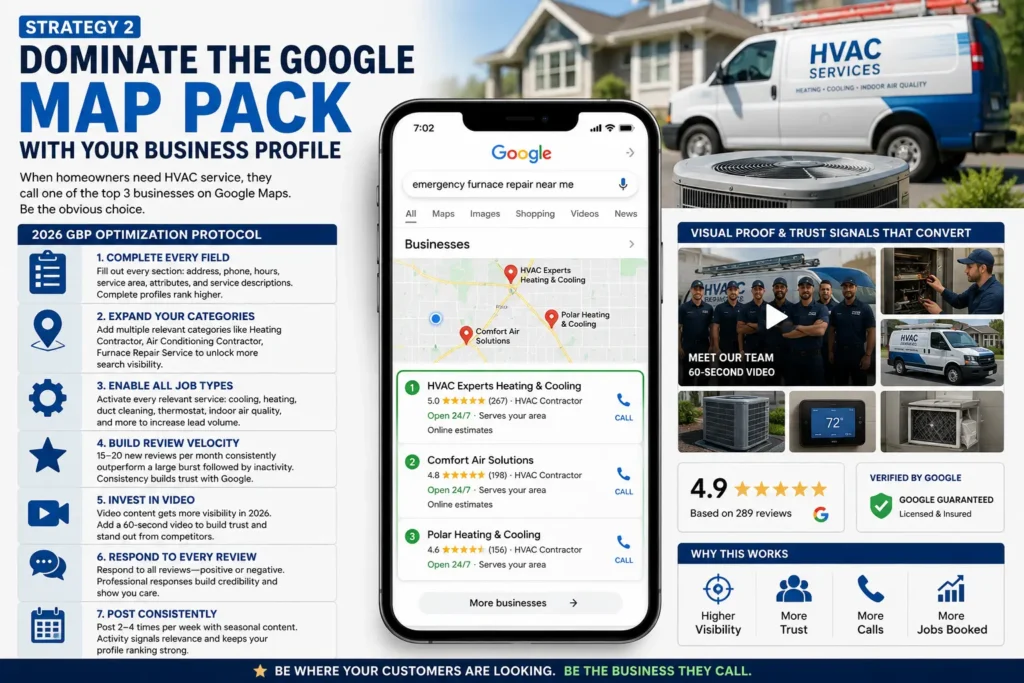
When a furnace fails at 7 PM in January, the decision-making process takes approximately 30 seconds. The homeowner opens their phone, searches “emergency furnace repair near me”, and calls the first business in the Map Pack that looks credible. Everything below that three-pack is invisible to a customer in crisis. Local SEO organic CPL for home services runs $10–$30 the best ROI channel once established. The contractors ranking in those top three positions aren’t there by accident. They’ve treated their Google Business Profile like the revenue-generating asset it is, not a directory listing to be claimed and forgotten.
2026 GBP Optimization Protocol:
Complete every available field. Address, local phone number (not a tracking number as the primary), service area, hours, attributes, and service descriptions. Incomplete profiles rank lower; Google interprets missing fields as reduced relevance signals.
Expand beyond the primary “HVAC” category. Most contractors select one category and move on. Adding heating contractor, air conditioning contractor, and furnace repair service as secondary categories unlocks distinct keyword ranking pools. Each category opens a separate tier of search visibility that a single-category profile structurally cannot access.
Enable every relevant job type. Profiles activating cooling, heating, duct cleaning, thermostat services, and indoor air quality options consistently generate higher lead volume at lower average CPL than single-category profiles.
Build and sustain review velocity. Fifteen to twenty verified reviews per month consistently outperform a single burst of 200 reviews with months of inactivity between them. Google’s local algorithm interprets sustained velocity as authenticity; compressed volume attracts scrutiny.
Invest in video in 2026. Google’s local interface now surfaces video more prominently than static images. A 60-second “meet the team” or “what to expect on your first service call” video creates an immediate trust differential against competitors whose profiles remain photo-only.
Respond to every review without exception. How a company handles a two-star review is often more instructive to prospective customers than the five-star ones. A measured, professional response to criticism demonstrates operational integrity that a stack of positive reviews alone cannot convey.
The execution gap most competitors ignore: The contractors dominate the Map Pack post two to four times weekly with content synchronized to the current season spring tune-up reminders in March, pre-summer readiness messaging in May, furnace preparation prompts in October. That consistent profile activity signals to Google that the business is current, engaged, and relevant. In a competitive local market, this discipline alone separates the first Map Pack position from the fourth.
Strategy 3: Local SEO The Asset That Generates Returns Long After You Stop Working
Paid advertising performs precisely as long as budget flows through it. The moment spend stops, visibility disappears. Local SEO operates on an inverted timeline the returns compound over months and years, independent of monthly ad spend. SEO takes 6–12 months but delivers leads at $10–$30 indefinitely. The best strategy is both: PPC for immediate flow while building SEO for long-term cost reduction. The implication for HVAC contractors is significant: every month of SEO investment reduces long-term customer acquisition cost while simultaneously improving the quality of inbound leads.
Phase 1 Build a service page architecture that matches search intent.
The structural mistake that undermines most HVAC websites: consolidating every service onto a single “Services” page. A homeowner searching “heat pump installation in [city]” should land on a dedicated page built entirely around heat pump installation in their city with realistic cost ranges, timeline expectations, process explanation, and local credibility signals. A generic page listing all services converts poorly at every stage of the funnel.
Create individual pages for every distinct service AC repair, furnace installation, duct cleaning, indoor air quality, thermostat replacement and create location-specific variants for every city within your service radius. Done properly, this architecture generates dozens of distinct ranking opportunities that a single-page site structurally cannot compete against.
Phase 2 Target keywords that signal buying intent, not merely search volume.
High-volume HVAC keywords “hvac” (247,000 monthly searches), “furnace repair” (64,000), “hvac near me” (63,000) are competitive and slow to rank. The faster path to qualified organic leads runs through long-tail, intent-rich queries: “cost to replace a 3-ton AC unit in [city],” “how long do HVAC systems last,” “signs my furnace needs replacement.” These terms carry lower volume but convert at significantly higher rates because the searcher has already moved through the awareness stage.
Phase 3 Create content that serves the customer’s actual research process.
A homeowner up at midnight Googling “why is my AC blowing warm air” is 12 hours away from calling an HVAC contractor. If your content answers that question more completely than anyone else’s, your company is the one they call in the morning. Publish blog posts and FAQ-style pages addressing the questions your customers ask before they know they need you. Local specificity consistently outperforms generic advice “how to prepare your AC for summer in Phoenix” ranks and converts better than “summer AC maintenance tips.”
Phase 4 Build the technical foundation that supports everything above.
Site speed is simultaneously a ranking signal and a conversion signal. One in four visitors abandons a site that takes more than four seconds to load. HVAC sites should load in under three seconds on mobile, display a click-to-call button above the fold, and maintain clean internal linking between service pages and location variants. Paid advertising like Google Ads can generate leads within the first week of launching. Organic strategies like SEO typically take three to six months to show significant ROI but provide a much lower cost per lead over the long term. Start now the compounding advantage begins the day the first page goes live.
Strategy 4: Google Local Services Ads The Highest-Intent Paid Channel in HVAC
If there is a single paid channel HVAC contractors should activate before all others, it is Google Local Services Ads. The structural advantage is fundamental: standard Google Ads charges per click regardless of whether the visitor calls, converts, or immediately leaves. LSA is a pay-per-lead model, not pay-per-click. Expect $15–$45 per lead for tune-ups and $50–$85 for replacement and emergency calls. The Google Guaranteed badge handles most of the conversion work.
LSAs appear above standard search ads and organic results on mobile, where the majority of “near me” contractor searches originate. They surface business hours, service area, and customer reviews before a prospect ever reaches your website pre-qualifying the lead before the phone even rings.
The response speed reality that determines whether LSAs are profitable: 78% of customers go with the first company that responds to them. Responding within 60 seconds can increase conversions by 391%, while waiting just five minutes slashes your chances of qualifying a lead by 80%. Despite these stats, more than half of contractors take five days or longer to respond to inquiries. An HVAC company that reduces their response time from 24 hours to just five minutes could transform a deeply negative ROI into an 85% profit margin.
Speed is not a soft advantage. It’s the difference between a booked job and a competitor’s win.
Implementation details that materially affect performance:
Review volume drives ad position. LSA rank is partly determined by review count and average rating. A profile with 75 reviews at 4.7 stars consistently outranks one with 20 reviews at 4.9. Volume and rating both contribute neither alone is sufficient in competitive markets.
Service area precision protects budget. Setting the geographic radius too wide generates leads from locations your crews can’t serve cost-effectively. LSA inventory is capped by your service area and star ratings, so it scales only so far. Start with your core city plus a 10–15 mile radius. Expand once the algorithm has sufficient performance data.
Dispute invalid leads systematically. From a dataset compiled across 100+ clients, a meaningful share of spend approximately 6–7% often comes back as credits for unqualified leads. Most contractors ignore this process entirely and leave money on the table every month.
Budget sequencing for new campaigns: Set Maximize Leads bidding mode for the first 60–90 days. The algorithm requires performance data before manual bid caps improve rather than impair results. Start with LSA if you have at least 25 Google reviews averaging 4.5 stars or higher and a service area of 30 miles or less. LSA offers the cheapest, highest-intent inventory in HVAC. Most contractors should maximize LSA spend before activating any secondary paid channel.
Strategy 5: Google Ads (PPC) Scaleable High-Intent Customer Acquisition
Once Local Services Ads are running and producing consistent lead flow, Google Search Ads become the primary scaling lever. No other channel matches the volume ceiling or the specificity of intent targeting available through search. Google Search is the highest-intent paid channel for HVAC. Emergency repair keywords “AC not blowing cold,” “furnace replacement near me” run $15–$28 per click in competitive metros. Tune-up and maintenance terms run $4–$11.
The variable that separates profitable PPC programs from expensive ones isn’t bidding strategy alone it’s landing page relevance.
The conversion architecture problem most HVAC companies have:
Routing a “heating repair near me” click to a general-purpose HVAC homepage is operationally the same as paying full ad cost to lose the lead. Every distinct ad group requires a corresponding landing page built for that specific service and intent with the service name in the headline, a phone number above the fold, trust verification immediately visible, and exactly one conversion action.
The offline conversion feedback advantage:
Connecting revenue and booking data to Google through platforms like RevSync allows Smart Bidding to optimize toward leads that generate completed revenue not leads that simply submitted a form. Contractors running offline conversion feedback typically observe sustained CPL reduction and lead quality improvement over rolling 90-day windows as the algorithm refines its audience model. This is a genuine competitive edge in 2026. Adoption among HVAC advertisers remains low.
Seasonal budget discipline: Top HVAC advertisers plan budgets 60–90 days ahead of seasonal peaks, run dedicated landing pages per service intent, and audit call recordings weekly. Entering peak season at the same budget you ran in February isn’t neutral it’s effectively a budget cut in real terms as CPCs rise around you.
2026 campaign architecture: Leading HVAC advertisers run simultaneous campaign types branded search for brand defense ($34 CPL), non-branded search for new customer acquisition ($45–$180 CPL), and Performance Max for algorithmic efficiency ($72 CPL). Let tracked cost per booked job determine which campaign type carries the highest proportional budget in your specific market.
Strategy 6: Social Media Precision Brand Development That Converts Later
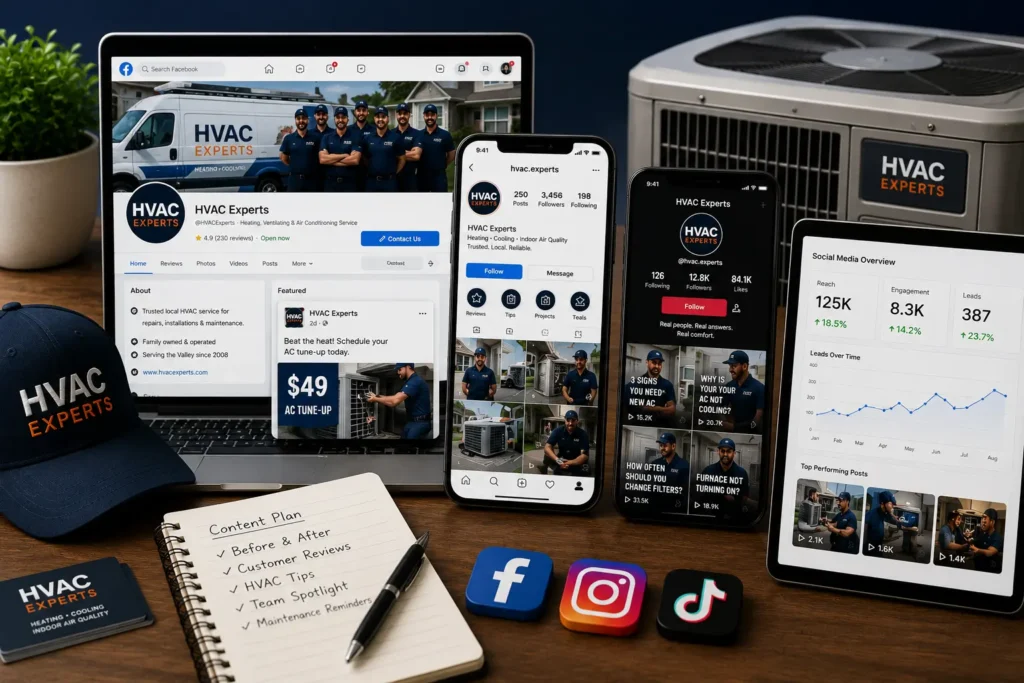
Social media will not replace your Google presence and conflating the two channels leads to misallocated expectations. What social media accomplishes that no paid search channel can is the sustained accumulation of familiarity, credibility, and contextual trust built over months before a homeowner needs you.
When a Phoenix homeowner’s AC fails on a Saturday in August and they have 90 seconds to find a contractor, the HVAC company that’s been showing up in their Facebook feed for six months has a structural advantage over one they found cold through a search result. That advantage is invisible in CPL reports. It shows up in close rates, price sensitivity, and inbound call quality.
Platform strategy by audience profile:
Facebook reaches homeowners aged 35–65 the demographic most likely to own aging HVAC systems and carry both the decision-making authority and budget for replacement. A Phoenix contractor systematically posting in eight local Facebook community groups weekly a two-hour time investment generates 12–15 monthly leads at approximately a 60% close rate and a $75 cost per sale. The investment is time, not ad spend.
Paid Facebook campaigns perform particularly well for maintenance offers and lower-ticket service specials. A “$49 AC tune-up” campaign generating leads at $36 each with a 30% close rate produces a $120 cost per sale but a meaningful percentage of those tune-ups identify systems requiring repair or replacement, escalating average revenue per acquired customer substantially.
Instagram performs best for younger homeowners seeking visual proof of work quality. Before-and-after installation photos, short technician walk-throughs, and review screenshots outperform promotional content on this platform.
TikTok reaches first-time homeowners who respond well to quick, practical content. Short videos answering questions like “3 signs your AC needs replacement” or “why your furnace keeps turning off” build authority with an audience that will need HVAC services for decades. Google Ads convert at 7.33%, and Facebook Ads at 5.22%, but rising ad costs make organic SEO and local strategies increasingly valuable. Use paid social to supplement Google not replace it.
Strategy 7: Review Generation The Trust Infrastructure That Closes Jobs Before the First Call
No marketing investment works in isolation from what a prospective customer finds when they look you up. For HVAC companies where the service involves a stranger entering someone’s home, diagnosing a system the homeowner can’t evaluate independently, and recommending work that may cost thousands of dollars online reviews are the trust verification that converts consideration into commitment. Phone leads boast a conversion rate of 46% nearly six times higher than the overall digital average. This explains why many businesses still focus on phone-first strategies, even as digital interactions continue to grow. Phone leads offer a distinct advantage: 37% of them convert during the very first call.
That conversion rate doesn’t happen at the point of the call. It’s built in the 30 seconds a homeowner spends reading your reviews before they dial.
The automated review generation system:
Text-based review requests sent within 24 hours of job completion consistently outperform email-only outreach. The workflow is deliberately friction-free: job marked complete in the CRM triggers an automated SMS with a direct Google review link. The customer clicks once, writes a brief review, submits. Total time: under two minutes. Total friction: near zero.
The velocity target matters as much as the total count. Fifteen to twenty verified reviews per month consistently outperform bulk-acquisition campaigns. Turning leads into customers relies heavily on response speed, the source of the lead, and how well the sales team performs. These elements explain why conversion benchmarks in 2026 show such wide variations. Review quality and recency are significant factors in that equation.
The strategic value of responding to criticism:
A company with 180 reviews and a thoughtful, non-defensive response to every critical review telegraphs operational maturity to prospective customers. A company with 300 reviews and zero engagement with criticism communicates the opposite. How a business responds when things go wrong is more instructive than how it presents when things go right. Every review response is a public-facing demonstration of company culture treat it accordingly.
Strategy 8: Referral Programs Converting Satisfied Customers into a Controlled Acquisition Channel
Referrals have always been the structural foundation of HVAC business development. The fundamental problem is not that referrals lack efficacy they convert at rates no paid channel approaches. Exclusive leads from your own marketing convert 3–4x better than shared leads and referral leads, arriving with personal endorsement attached, outperform even those.
The problem is that most companies leave referral generation entirely to chance. Passive word-of-mouth produces inconsistent, unpredictable volume. Engineered referral systems produce consistent, measurable volume at the lowest cost per acquisition of any proactive marketing channel.
The referral program structure that produces reliable returns:
Concrete incentive structures $50 off the referring customer’s next service, $100 in account credit for each successfully booked referral consistently outperform vague goodwill asks. The offer needs to be specific, valuable, and communicable in a single sentence.
A Denver contractor offering $100 account credit for successful referrals generates 15–20 new customers monthly at near-zero acquisition cost. At an average first-job ticket above $400 and a 70%+ retention rate into maintenance agreements, the credit cost recovers within the first interaction.
Train technicians to surface the referral ask at the highest-satisfaction moment in the customer relationship immediately after a successful service resolution, when the customer is expressing approval. The conversion window is brief. If the ask isn’t made in that moment, it rarely surfaces later.
Strategic trade partnerships extend the referral network beyond direct customers:
Real estate agents, plumbers, roofers, general contractors, and property managers interact with homeowners who are either actively dealing with HVAC issues or will be soon. A single productive real estate agent relationship generates six to twelve qualified referrals annually at zero acquisition cost beyond the relationship investment. Identify and formally structure these partnerships with mutual incentive structures and consistent communication.
Strategy 9: Your Website The Conversion Infrastructure Everything Points To
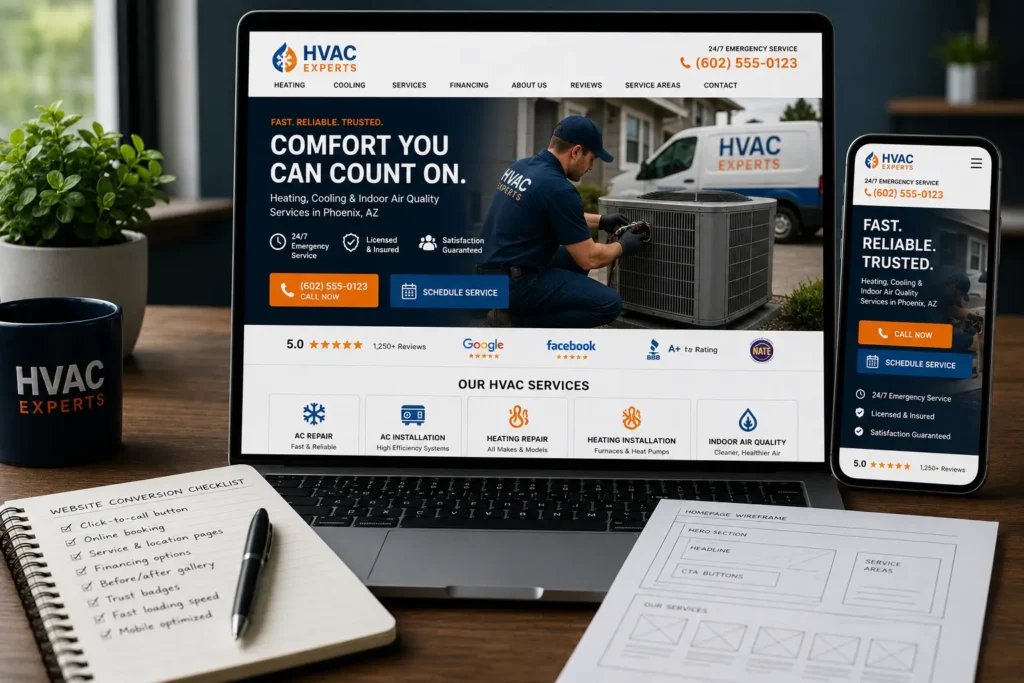
Every dollar allocated to advertising, every review earned, every LSA position achieved the commercial value of all of it is ultimately realized or squandered on your website. A high-performing multi-channel lead generation program built on top of a slow, vague, friction-heavy website is a pipeline with a structural leak.
Your website’s job is to make the next step effortlessly obvious to a customer who is often stressed, time-pressured, and evaluating two competitors simultaneously.
The conversion architecture checklist:
| Page Element | Conversion Function |
|---|---|
| Click-to-call phone (above fold on mobile) | Captures the 90%+ of HVAC LSA leads that arrive by phone |
| Online booking widget | Converts leads during off-hours when staff is unavailable |
| Dedicated service + location pages | Matches search intent precisely; reduces bounce rate materially |
| Financing options prominently displayed | Eliminates the most common objection in equipment replacement |
| Before/after installation gallery | Visual proof that bypasses the need for extended explanation |
| Response time commitment | “We reply within 15 minutes” converts skepticism into confidence |
| Emergency service CTA | Captures the highest-value, highest-urgency leads at the decision moment |
| NATE certification, EPA, BBB badges | Resolves the “can I trust them?” question before it’s asked |
A standard one-to-two-truck HVAC business should expect to invest between $1,500 and $2,500 per month for foundational lead generation. This budget typically covers local SEO, Google Business Profile management, and basic paid search campaigns to establish a local presence. That investment is wasted if the website it drives traffic to doesn’t convert.
Run your mobile site through Google PageSpeed Insights before making any other website investment. A perfectly written service page that loads in six seconds converts worse than a sparse page that loads in two.
Strategy 10: Lead Platform Diversification Pipeline Stability While Organic Channels Scale
Lead platforms are a controlled bridge valuable when entering new service areas, accelerating growth against a tight timeline, or filling pipeline gaps while local SEO builds authority. Used with clear expectations and rigorous performance tracking, they complement an owned-channel strategy effectively. Substituted for one, they create expensive dependency. Shared leads are cheap because the lead generation company sells the exact same homeowner’s contact information to you and several of your competitors. This forces you into a bidding war, drastically lowering your closing rate.
The fundamental rule for platform evaluation: measure cost per completed job, not cost per lead. A channel with cheap leads and a 5% close rate can cost more per dollar of revenue than a channel with expensive leads and a 25% close rate. Channel A can have 3x the CPL but 575% ROI.
HVAC Lead Platform Comparison 2026
| Platform | Lead Type | Cost Range | Optimal For |
|---|---|---|---|
| Google LSA | Exclusive | $15–$85/lead | All company sizes; highest verified intent |
| Angi (HomeAdvisor) | Shared/Exclusive | $20–$100+ | Established companies requiring rapid volume |
| Thumbtack | Shared | $15–$75 | Growth-stage contractors entering new markets |
| Service Direct | Exclusive pay-per-call | Variable | Results-driven programs without long-term contracts |
| 99 Calls | Exclusive | Monthly plan | Organic-first contractors supplementing SEO |
HomeAdvisor/Angi leads average $25–$85 depending on category but are shared with competitors exclusive leads from your own marketing convert 3–4x better.
Before committing to any platform, request documented conversion data for contractors in comparable markets. If the platform cannot produce cost per booked job data not lead volume, not CPL that response itself is instructive about what they actually track.
🔍 Free Website Audit Is Your HVAC Site Converting or Costing You?
Most HVAC contractors spend thousands driving traffic to a website that quietly loses half the leads it receives. Slow load times, buried phone numbers, missing trust signals, and generic service pages bleed revenue every month without a single alert or notification. Our free HVAC website audit analyzes your site across 27 conversion checkpoints including mobile speed, click-to-call placement, service page structure, local SEO readiness, and trust signal visibility and delivers a prioritized action plan showing exactly where leads are slipping through and what to fix first. No contracts. No obligations. Just a clear, honest assessment of whether your website is working as hard as the rest of your marketing.
[→ Contact Us ]
The Seasonal HVAC Lead Generation Playbook
The most consequential gap in competitor content on this topic is the complete absence of seasonal strategy. HVAC is an inherently seasonal business with predictable demand cycles. A marketing program that doesn’t account for those cycles either overspends during slow periods or enters peak season underprepared both are avoidable problems with clear solutions.
Spring (March–May): Your Highest-Leverage Conversion Window
The strategic advantage of spring is psychological: homeowners are thinking about summer heat but haven’t yet experienced the urgency of a failure. They’re in a preventive mindset open to booking appointments before peak demand drives up wait times and competitor bidding drives up CPCs.
- Ramp Google Ads and LSA bids 20–30% beginning in late March before competitors register the demand signal and costs rise around you
- Deploy your pre-season email campaign to all prior-year customers: “Is your AC ready for summer? We’re booking now and slots fill fast.”
- Accelerate LSA bids on cooling keywords “AC tune-up,” “air conditioning maintenance,” “spring HVAC service”
- Offer early-booking incentives limited technician availability is real in April, and communicating it is a trust signal, not a sales tactic
Summer (June–August): Maximum Execution Discipline
This is where annual revenue is determined. Every unfielded call in July represents a job and likely a customer relationship transferred permanently to a competitor.
- Emergency keywords command premium placement. “AC not blowing cold,” “emergency AC repair,” and “air conditioning replacement” run $15–$28 per click in competitive metros. At average replacement tickets of $8,000+, the acquisition math is not a close call.
- 24/7 call coverage is non-negotiable. A lead that reaches voicemail at 9 PM in August calls the next number on the list. Answering services and AI-powered intake tools prevent this. Deploy them before June.
- Retargeting converts hesitant visitors. Prospects who landed on your site without converting should encounter your ads across Google Display, Facebook, and YouTube with messaging calibrated to the specific service page they viewed, not a generic brand ad.
Fall (September–November): The Season Most Companies Underestimate
Fall carries a strategic opportunity the majority of HVAC contractors leave entirely uncaptured. Homeowners with aging heating systems know winter is approaching. They’re in a preventive mindset before the first cold snap creates urgency and compresses their decision window.
- Pivot all campaign messaging to heating furnace tune-ups, heat pump efficiency assessments, and system age conversations
- Email framing: “Before the first freeze: Is your furnace ready for winter?” specific, timely, and actionable without manufactured urgency
- Maintenance agreement conversion peaks in fall. The preventive mindset makes annual service contracts a far easier conversation than crisis-driven summer calls
- Target older housing stock directly. Facebook and direct mail campaigns geo-targeted to neighborhoods built 10–15 years ago reach the homeowners most likely to need system replacement within 12–24 months
Winter (December–February): Build Infrastructure, Not Dependency
The companies that use this window strategically emerge in spring with stronger organic rankings, richer content libraries, and a maintenance base that smooths revenue curves for the year ahead.
- Maintain LSA presence for emergency heating keywords. Furnace failures in January are high-ticket, high-urgency, and high-conversion. The cost of maintaining visibility is justified by the return.
- Invest in content creation and technical SEO. Google Ads CPCs drop in winter. Content created now ranks by spring. This is the most cost-efficient window to build organic infrastructure that compounds all year.
- Pre-book spring maintenance appointments in February with early-access pricing. Homeowners who commit in February don’t call a competitor in May.
- Develop commercial HVAC relationships. Commercial demand is comparatively stable year-round property managers, building owners, and multi-unit operators reduce residential seasonality dependency when added to your client mix.
The Performance Tracking Framework That Actually Informs Decisions
The single most consequential shift in HVAC marketing management is replacing CPL-centric reporting with a cost-per-booked-job dashboard. The former optimizes for lead volume. The latter optimizes for revenue. Every HVAC owner knows their cost per lead. Almost none know their cost per booked job. The gap between those two numbers is where most marketing budgets go to waste.
| Metric | Operational Value |
|---|---|
| Cost per lead by channel | Identifies where to increase and reduce investment |
| Lead-to-appointment rate by channel | Measures lead quality, not just volume |
| Appointment-to-booked-job rate | Reveals CSR and sales team performance |
| Cost per booked job by channel | The actual ROI comparison across your channel mix |
| Average ticket by lead source | Identifies which channels attract high-value work |
| Average Sale Per Lead (ASPL) | True revenue-generating power of your marketing investment |
| Customer Lifetime Value (CLV) | Long-term value of each acquisition source |
A “good” CPL is any number that keeps your LTV-to-CAC ratio at 3:1 or better. Track this ratio monthly, not annually. A rising CPL paired with a rising conversion rate and strong LTV is a program scaling efficiently. A declining CPL paired with a declining close rate is a warning signal, regardless of how the surface metrics appear.
Implement call tracking from day one. 90%+ of LSA leads are phone calls. Without call tracking infrastructure through CallRail or WhatConverts, channel attribution is guesswork. With it, every budget decision is anchored to actual revenue data.
AI Tools in HVAC Marketing: What’s Actually Worth Using in 2026
AI and automation are driving efficiency gains across HVAC marketing. The tools delivering measurable value in 2026 fall into three practical categories:
Conversational AI for after-hours lead capture: AI-powered chat and intake tools handle inbound inquiries when phones aren’t staffed. A homeowner who reaches an AI intake assistant at 11 PM on a Sunday receives an immediate response, confirms an appointment window, gets a confirmation text is far less likely to call a competitor Monday morning than one who reached voicemail.
Automated bidding optimization: Google’s Smart Bidding algorithms, when fed accurate offline conversion data, consistently outperform manual bidding for contractors with sufficient historical data. The key qualifier: campaigns running under 30 conversions per month benefit less from algorithmic optimization than those with higher conversion volume. Let the data mature before switching.
Content and SEO efficiency: AI-assisted content drafting reduces the time cost of publishing regular blog posts and location pages. The value isn’t the AI output it’s the reduction in the barrier to consistent publication that SEO rewards over time. CRM systems and follow-ups are essential to avoid losing leads, as 79% fail to convert without proper nurturing. AI tools amplify nurture capacity they don’t replace the strategy behind it.
Your HVAC Lead Generation Technology Stack
Operational execution at scale requires the right infrastructure. The technology layer is not incidental to performance it’s what enables a disciplined system to function without constant manual intervention.
| Category | Function | Leading Options |
|---|---|---|
| CRM + Field Management | End-to-end lead tracking and job management | ServiceTitan, Jobber, Housecall Pro |
| Call Tracking | Channel attribution and conversion analysis | CallRail, WhatConverts |
| Review Automation | Systematic post-job review generation | NiceJob, Podium, Birdeye |
| Email + SMS Automation | Customer reactivation and nurture sequences | HubSpot, Keap, ActiveCampaign |
| Website Analytics | Traffic source and conversion path tracking | Google Analytics 4 |
| Offline Conversion Feedback | Revenue data integration with Google Ads | RevSync |
| AI Intake / Chat | After-hours lead capture and qualification | Hatch, Signpost, Structurely |
| Social Scheduling | Consistent content cadence management | Buffer, Hootsuite |
Evaluating an HVAC Marketing Agency: The Due Diligence Standard
Most HVAC companies that have worked with an outside marketing agency share a version of the same experience: high initial promises, opaque reporting, and CPL data that never connects to actual revenue performance. The agency relationship is expensive to exit once operational dependency is established which makes the evaluation process critical. Many owners end up throwing money at unproven tactics without tracking the real cost. Some HVAC companies promise cheap leads for a few dollars, while a full-service marketing company might quote thousands of dollars per month. This lack of pricing clarity makes it difficult to plan your marketing dollars properly and protect your profit margins.
The questions that separate capable agencies from expensive overhead:
- “Can you provide documented results from HVAC clients in comparable markets with actual lead volume, CPL, and cost-per-booked-job data?” Logos and case study PDFs are not evidence. Specific, comparable metrics are.
- “What does monthly reporting look like, and can I see a sample?” If the report shows impressions and clicks but not cost per booked job by channel, the agency is measuring the wrong outcomes.
- “Do you use call tracking, form attribution, and CRM integration?” These are table stakes not advanced capabilities. An agency without them cannot tell you whether your marketing is working.
- “Who manages this account day-to-day and what is their HVAC-specific experience?” Senior strategists who pitch the account and junior coordinators who manage it is a standard industry pattern. Clarify the arrangement before signing.
- “What happens to my assets website, ad accounts, content if the relationship ends?” Everything built during the engagement should belong to you. Contracts that transfer asset ownership upon departure are retention mechanisms disguised as partnership terms.
- “How do you handle performance shortfalls what’s the process, and what’s the accountability?” A confident agency answers this question directly. An evasive answer is itself informative.
FAQ: HVAC Lead Generation
What is a good cost per lead for HVAC?
HVAC lead generation costs run $15–$85 per lead on Local Services Ads, $45–$180 on Google Search, and $25–$95 on Meta with cost per booked job ranging $90–$350 depending on channel and offer. HVAC and Home Services see blended average costs around $92 because local businesses can generate leads via word-of-mouth, local SEO, and repeat customers at minimal marketing expense. A “good” CPL is any number that keeps your LTV-to-CAC ratio at 3:1 or better.
How do I generate HVAC leads without paid advertising?
Local SEO organic CPL for home services runs $10–$30 the best ROI channel once established. Google LSA is the fastest path to high-quality exclusive leads at $35–$120 CPL depending on trade. Free and near-free strategies include optimizing your Google Business Profile, automated review generation, email reactivation campaigns to past customers, and structured referral programs with concrete incentives.
Are Google Local Services Ads worth it for HVAC companies?
LSA is a pay-per-lead model, not pay-per-click. Expect $15–$45 per lead for tune-ups and $50–$85 for replacement and emergency calls. The Google Guaranteed badge handles most of the conversion work. Start with LSA if you have at least 25 Google reviews averaging 4.5 stars or higher and a service area of 30 miles or less. LSA offers the cheapest, highest-intent inventory in HVAC.
What is the highest-ROI HVAC marketing channel?
For existing customers: email marketing, which generates $36–$40 per $1 spent. SEO takes 6–12 months but delivers leads at $10–$30 indefinitely making it the highest-ROI channel for new customer acquisition over a 12-month horizon. For immediate paid acquisition: Google LSAs at $15–$85 per lead with 40–55% close rates.
How much should an HVAC company spend on marketing?
Most HVAC companies spend 5–10% of gross revenue on marketing. For a $1M company, that is $50,000–$100,000 per year. But efficiency matters more than amount. A contractor spending $3,000/month with 80% booking and 5% no-shows generates more revenue than one spending $8,000/month with 46% booking and 18% no-shows.
What do phone leads convert at for HVAC companies?
Phone leads boast a conversion rate of 46% nearly six times higher than the overall digital average. Phone leads offer a distinct advantage: 37% of them convert during the very first call. 90%+ of LSA leads are phone calls making click-to-call optimization and live call coverage the most immediate conversion improvements available to HVAC contractors.
What is the difference between exclusive and shared HVAC leads?
Shared leads are cheap because the lead generation company sells the exact same homeowner’s contact information to you and several of your competitors. This forces you into a bidding war, drastically lowering your closing rate. Exclusive leads from your own marketing convert 3–4x better than shared leads. Shared leads can produce positive ROI only for contractors with response infrastructure capable of engaging within 60 seconds.
How long does HVAC SEO take to produce results?
Paid advertising like Google Ads can generate leads within the first week of launching. Organic strategies like SEO typically take three to six months to show significant ROI but provide a much lower cost per lead over the long term. Full competitive rankings in larger markets typically build over 6–12 months. The compounding nature of SEO makes starting now the most asymmetric investment available in HVAC marketing.
How quickly should HVAC companies respond to inbound leads?
78% of customers go with the first company that responds to them. Responding within 60 seconds can increase conversions by 391%, while waiting just five minutes slashes your chances of qualifying a lead by 80%. For after-hours leads, AI-powered intake tools or live answering services prevent the most common and costly lead-loss event in HVAC marketing: a qualified prospect reaching voicemail and immediately calling a competitor.
How do I maintain HVAC lead flow during the slow season?
The most effective strategy is to prevent slow seasons structurally rather than react to them tactically. Sell maintenance agreements in fall and spring these create predictable recurring revenue that insulates the business from seasonal demand cycles. Pre-book spring maintenance appointments in February with early-access pricing. Organic strategies like SEO take three to six months to show significant ROI but provide a much lower cost per lead over the long termmaking winter the optimal window for building the content infrastructure that generates leads throughout the year ahead.
The Action Plan: Prioritized by Impact and Execution Speed
The gap between a comprehensive strategy and a functioning pipeline is execution sequence. Here is exactly where to focus and in what order.
This week: Audit your Google Business Profile complete every empty field, expand to all relevant service categories, upload 10+ team and job-site photos, and enable every applicable job type. Connect your CRM to an automated review request trigger firing within 24 hours of job completion. Run your mobile site through Google PageSpeed Insights and establish your load-time baseline.
This month: Apply for Google Local Services Ads if not currently active. Export your customer list, build your first segmented reactivation email sequence, and deploy it against your equipment-age and lapsed-customer segments. Assign unique call tracking numbers through CallRail or WhatConverts to every traffic source.
This quarter: Build dedicated service pages for every distinct service with location-specific variants for every city in your active service radius. Launch a referral program with a concrete incentive and train technicians to surface it at the right moment. Build a seasonal marketing calendar with budget escalation points planned 60 days before each demand peak.
This year: Develop content addressing the top 20 questions homeowners in your market are actively searching. Formalize two to three strategic trade partnerships with real estate professionals or complementary contractors. Implement offline conversion tracking to integrate job revenue data with your Google Ads bidding algorithm. Build toward a maintenance agreement base that generates predictable recurring revenue through every slow season that follows.
The HVAC companies that will own their local markets over the next decade are not necessarily the largest or the oldest. They are the ones who apply the same operational discipline to lead generation that they apply to service quality systematic, measurable, continuously refined, and built on infrastructure rather than hope. Understanding your HVAC lead generation cost comes down to prioritizing ROI over the initial price tag. While it might be tempting to save money upfront with a budget provider, the long-term cost of poor lead quality and stagnant growth will ultimately hurt your business.
Build the system. Track what matters. Reinvest in what performs. The schedule fills from there.