
If your HVAC company isn’t in the top three Google Maps results when someone nearby searches for heating or cooling help, you’re essentially invisible to that customer. Forty-four percent of all local search clicks go to those three positions — what SEOs call the Local Pack or 3-Pack. When someone’s furnace quits in January or their AC blows warm air in July, they’re not comparing options. They’re calling whoever appears first.
HVAC local SEO is the work of making your company show up when someone nearby searches for heating, cooling, or air quality services — across your Google Business Profile, your website, your citation footprint, and your review record. It’s distinct from general local SEO in ways that matter, and treating the two as interchangeable is one of the costlier mistakes HVAC contractors make.
This article lays out a contractor-specific system: what to build, in what order, and what most of your competitors are quietly getting wrong. It’s one component of a larger HVAC digital marketing strategy — if you want to see how local SEO connects to Google Ads, Local Services Ads, and email, that guide covers the full picture. Here, we go deep on one thing: getting your company into the 3-Pack and keeping it there year-round.
What HVAC local SEO actually is — and why it doesn’t work like other local businesses
The mechanics of local SEO apply to any business: Google Business Profile, citations, reviews, on-page content. What changes in HVAC is the environment those mechanics have to operate in — urgency-driven searches, hard geographic limits, extreme seasonal swings, and a crowded market where a handful of 3-Pack positions are all that matter.
The three signals Google weighs for every local search
Google’s local ranking algorithm evaluates businesses on three published factors: relevance, distance, and prominence. When someone searches “AC repair near me,” Google runs this multi-factor calculation before deciding which three businesses to show.
Distance — how close your verified business location is to the person searching. You can’t move your address, but you can extend your geographic relevance through service area configuration and city-specific content.
Relevance — how well your profile and website match the actual query. Your categories, services list, and website content all feed this signal. A profile that says “HVAC contractor” and nothing else is invisible for the majority of queries your customers actually type.
Prominence — Google’s overall confidence in your business. Reviews, citation consistency, backlinks from local sources, and how actively you use your profile all feed prominence. Think of it as reputation, translated into ranking signals.
In short: a business that’s close, clearly relevant to the search, and trusted by Google’s systems wins the 3-Pack. All of HVAC local SEO is optimizing those three levers.
Four things that make HVAC local SEO different from the standard playbook
Nobody flies in an HVAC technician. Geographic proximity is a hard ceiling. If a homeowner is six miles from your address and you have no service-area content for that geography, your competitor two miles closer wins by default — even if you have triple the reviews they do.
HVAC searches are often emergency signals, not comparison queries. “AC not cooling” typed at 3pm on a 97-degree Thursday isn’t someone researching options. They’re calling the first company that appears. There’s no browsing phase, no second tab open. The speed at which you appear is the product.
Demand swings 300–500% between seasons. Your search volume in July looks nothing like February. Any local SEO strategy that doesn’t account for this timing will perpetually optimize too late — publishing content into a market that’s already decided who to rank. Mobile and voice searches (“Hey Google, find an HVAC company near me”) amplify this dynamic during peak weather events, when customers are reaching for their phones, not laptops.
You’re in a genuinely crowded market. Roughly 146,000 HVAC businesses operate in the U.S. In any mid-sized metro, dozens of companies are competing for the same 10–15 core 3-Pack positions. Generic local SEO advice doesn’t account for how that density plays out.
Your Google Business Profile: the highest-leverage thing you can optimize for free
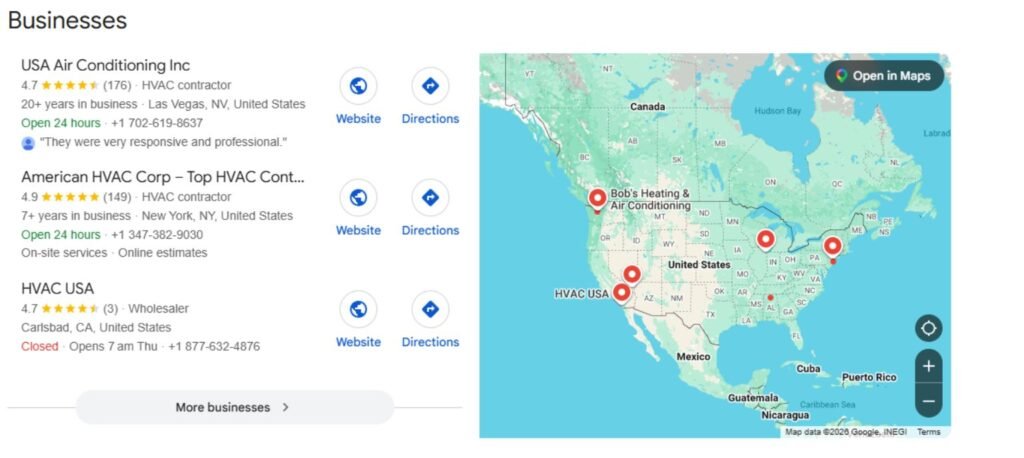
If you had to choose one lever to pull, GBP is it. Google uses your profile as the primary data source when building your 3-Pack listing. An incomplete or neglected profile costs you rankings you’d otherwise earn without any additional budget.
What separates a basic GBP from a fully optimized one isn’t just filling in fields — it’s understanding which fields carry real ranking weight, what Google actually does with that information, and where your competitors are almost universally leaving opportunity on the table.
Claiming and verifying: the step you can’t skip
Before anything else, your profile needs to be claimed and verified. An unclaimed profile is one Google can edit using third-party data — data that may be wrong, outdated, or pulled from a former location. More importantly, Google won’t prominently rank a business that hasn’t verified its existence.
Verification most commonly happens by postcard (Google mails a code to your business address). Phone and video verification are increasingly common alternatives. If you operate as a service-area business — a van-based operation without a customer-facing storefront — you can hide your address and set service areas instead. You still need to verify. Google uses your address internally for proximity calculations even when it’s hidden from the public listing.
One thing that catches contractors off guard: if a previous employee or marketing vendor set up your profile years ago, you may not have access to it. Search for your business on Google Maps before assuming you own your listing. More than a few contractors have been optimizing a profile they don’t control.
The GBP category matrix — the section most guides skip
Your primary category is the single strongest relevance signal you directly control. For most HVAC companies, “HVAC contractor” is the right primary choice. Stopping there, though, makes you invisible for a large share of high-intent, service-specific searches.
Secondary categories are additional relevance triggers. Each one makes your profile eligible to surface for a different cluster of queries. Here’s how the matrix works in practice:
| Category | Queries it helps you rank for |
|---|---|
| HVAC contractor (primary) | “HVAC company near me,” “HVAC contractor [city],” “HVAC services” |
| Air conditioning repair service | “AC repair near me,” “air conditioning repair [city],” “central air not cooling” |
| Heating contractor | “heating contractor [city],” “heating repair near me,” “heating system installation” |
| Furnace repair service | “furnace repair,” “furnace not working,” “furnace tune-up near me” |
| Air duct cleaning service | “duct cleaning near me,” “air duct cleaning [city],” “HVAC duct cleaning” |
| Heat pump installation service | “heat pump installation,” “heat pump installer near me,” “heat pump replacement” |
A company using all six is competing across six distinct query clusters. A company that stops at the primary is competing across one. That’s not a minor difference — it’s a structural gap that plays out as missed calls every single day.
One firm rule: never stuff keywords into your business name to compensate. “Smith HVAC AC Repair Furnace Heating Contractor” is a Google policy violation and a common reason for listing suspensions. Done correctly, category selection handles the relevance work that keyword stuffing tries to force.
Services, description, and hours: what most contractors leave half-empty
Your services list inside GBP is a secondary relevance signal that almost every HVAC company underuses. Most contractors either leave it blank or enter single-word entries like “AC repair.” Google can match service entries to specific queries, which means specificity directly affects your eligibility.
Instead of “AC repair,” write “Air conditioning repair and diagnostics.” Instead of “installation,” write “Central air conditioning installation” and “Heat pump installation and replacement.” Add 2–3 sentences to each service using the natural language a homeowner would use to describe the problem — not industry terminology.
Your business description gets 750 characters. Use around 500. Open with what makes your company specifically credible — years in operation, service area, certifications — then mention your core services naturally in context. Don’t treat it as a keyword list. Google reads descriptions for topical relevance, and homeowners read them to decide whether you’re worth calling.
Business hours need to be accurate and actively maintained. If you offer 24/7 emergency service, use the dedicated field to say so. If your hours change seasonally — most HVAC companies extend their windows during summer and winter peaks — update them before the season starts, not after the calls slow down.
Photos and Google Posts: the activity signals Google tracks
Google’s local algorithm includes an activity score — a measure of how current and engaged your profile appears. Two of the strongest inputs to that score are photo uploads and Google Posts.
The research is consistent: profiles with regular photo activity receive significantly more direction requests and website clicks than dormant ones. The types that perform best for HVAC aren’t stock images of equipment or thermostat close-ups. They’re photos of your uniformed technicians at real job sites, your branded service vehicles in recognizable neighborhoods, before-and-after shots of clean equipment installations. A photo of a heat pump install with a local landmark in the background does more for your local relevance than any stock photo.
In 2026, Google is weighting short vertical video on GBP listings more heavily than static photos — a pattern clearly visible in the profiles ranking at the top of competitive HVAC markets. A 30–60 second clip of a technician walking through a maintenance checklist, completing an install, or explaining a common problem consistently outperforms adding more still images. Almost no HVAC companies are doing this yet, which makes it one of the most accessible competitive advantages available right now.
Google Posts function as a lightweight activity feed on your profile. Post weekly. Seasonal offers, service reminders, availability updates. “Summer AC tune-up appointments are now available — book before June and save $30 on a full system check” is enough. The goal is consistent activity, not content marketing.
Q&A preloading: the feature your competitors are ignoring
The Q&A section of your GBP is publicly visible and publicly editable. Anyone can add a question; anyone can post an answer. Most HVAC companies ignore it entirely and hope nothing problematic shows up.
The better approach: preload it yourself with the 6–8 questions your dispatcher actually fields every day.
Do you offer same-day emergency HVAC service? Yes — we offer 24/7 emergency HVAC service for heating and cooling failures. Call [number] for immediate dispatch.
Do you service all HVAC brands? We service all major brands including Carrier, Trane, Lennox, Rheem, and Goodman. Our technicians are NATE-certified.
Do you offer financing on new system installations? Yes, we offer financing through [partner] with approved credit. Ask about 0% APR for 18 months on qualifying equipment.
Each answer serves two purposes: it’s a relevance signal (Google treats Q&A content as part of your profile’s topical footprint) and a sales tool that handles common objections before the homeowner ever picks up the phone.
A note on GBP spam and competitor manipulation
One thing contractors rarely talk about: GBP spam is real and common in HVAC. Competitors with keyword-stuffed business names (“Bob’s HVAC AC Repair Heating Cooling [City]”), fake reviews arriving in sudden bursts, and duplicate listings are all violations — and all reportable through Google’s Business Redressal Complaint form. If you’re losing 3-Pack positions to a listing that looks suspicious, it’s worth investigating before assuming you have a rankings problem. Google doesn’t always catch these proactively.
NAP consistency and citation building: the silent ranking problem
Your NAP — Name, Address, Phone number — is the identity fingerprint Google uses to verify your business is real and consistently located. When it matches across dozens of directories, review platforms, and local listings, it reinforces your prominence score. When it doesn’t, it creates a confidence problem that suppresses your rankings without triggering any visible error.
Why even small mismatches matter
The discrepancies don’t need to be dramatic to cause damage. “123 Main Street” versus “123 Main St.” Google can treat these as different entities. “Smith HVAC LLC” versus “Smith HVAC” — same problem. A phone number listed with a different area code format. An old address still appearing on three directories after you moved two years ago.
The cumulative effect is that Google becomes less certain your business is who it says it is — and certainty is a ranking input. Competitors with cleaner citation profiles win on proximity-to-prominence comparisons even when you have more reviews.
Where to be listed first: the HVAC citation priority list
Not all directories carry equal weight. Work through this in order:
Tier 1 — highest authority, fix these first: Google Business Profile, Yelp, Better Business Bureau, Angi, HomeAdvisor
Tier 2 — industry and local authority: Houzz, Thumbtack, your local Chamber of Commerce directory, the ACCA member directory, Nextdoor Business
Tier 3 — supplementary local directories: City-specific business directories, neighborhood association sites, local news outlet business listings
Tools like BrightLocal and Whitespark run citation audits that surface every place your NAP appears online and flag inconsistencies. For most HVAC companies operating more than three years, that audit turns up 15–30 discrepancies — the majority fixable in a few hours. For a full HVAC-specific directory list with submission guidance, see the HVAC citation building guide.
How to audit and fix citation problems
- Run a citation audit through BrightLocal or Whitespark. Export the full report — every mention of your business name, address, or phone number across the web.
- Flag every listing where the NAP doesn’t exactly match your current, verified GBP information. Your GBP is the master record.
- Prioritize Tier 1 corrections first. Log in directly and update. For sites where you can’t claim ownership, use the “suggest an edit” feature or contact the platform.
- Suppress or remove duplicate listings. If Google finds two listings for the same business, it may show neither confidently in the 3-Pack.
- Set a calendar reminder to re-audit every six months. Citation drift happens — platforms auto-update from aggregators, and old information resurfaces.
The first audit takes most contractors 4–6 hours. After that, maintenance is minimal if you catch drift early.
Service area pages: how to rank in the cities where your trucks actually drive
Here’s a scenario that plays out constantly: an HVAC company based in Scottsdale ranks well in Scottsdale. They also serve Tempe, Mesa, Chandler, and Gilbert — and in those cities, they’re completely invisible. Their competitor based in Mesa owns Mesa while the Scottsdale company loses leads 12 miles from their own office.
The fix is dedicated service area pages. Not one combined “areas we serve” page. Individual pages — one per city or significant neighborhood you serve.
Why the “areas we serve” page doesn’t rank
The typical “areas we serve” page has a bulleted city list, maybe a Google Map embed, and a generic paragraph about serving the greater metro area. Google can’t rank that page for “AC repair in Chandler” because it isn’t about AC repair in Chandler. There’s no dedicated URL for that query, no content demonstrating service authority in that geography, no signal that your company has specific expertise and presence in that city.
A dedicated service area page for Chandler gives Google a URL it can rank for “[service] Chandler AZ” queries. It gives homeowners in Chandler content that feels written for them. And it compounds over time — one page working for every searcher in that geography, indefinitely.
What a high-ranking HVAC service area page includes
The goal is a page that feels genuinely written for people in that city — not a template with the city name swapped in. Google’s algorithms are good at detecting thin, duplicated local pages, and they rank them accordingly.
A page that consistently ranks includes:
- H1 with city and primary service: “AC Repair and HVAC Services in Chandler, AZ”
- Unique local content: A paragraph or two referencing something specific to that area — local climate quirks, common equipment issues in that geography, neighborhoods served. Doesn’t need to be long; needs to be real.
- LocalBusiness schema markup — structured data that explicitly tells Google your business serves that city, with the service area’s coordinates. If you haven’t implemented schema before, it’s a JSON-LD code block added to your page’s HTML; your web developer or platform can handle it in under an hour.
- Embedded Google Map centered on that service area
- Testimonials from customers in that city — two or three pulled from your Google reviews, with the reviewer’s city noted
- Services offered in that area with brief descriptions that naturally target local queries
- A clear CTA above the fold — click-to-call, not buried below the fold
- Internal links to your core service pages
Target 600–900 words. If you can’t write genuinely unique content for 15 different cities, prioritize the highest-volume areas first and expand over time. For page templates, schema code examples, and a full ranking walkthrough, see the HVAC service area pages guide.
The internal linking structure that multiplies authority
Architecture matters as much as the individual pages. Your Chandler area page should link to your “AC Repair in Chandler” service page and your “Furnace Installation Chandler” page. Those pages link back to the Chandler area page. This cross-linking structure tells Google your company has comprehensive coverage across both geography and service type — and passes authority in both directions.
One detail almost nobody uses: in your GBP, the “website” field typically defaults to your homepage. Point it instead to your primary city’s service area page — the one matching your verified business address. This sends more relevant geographic context to Google than a homepage link.
Review velocity strategy: the ranking factor that compounds every month
Most HVAC owners think about reviews in terms of total count. “We have 87 reviews — that’s solid.” The number that actually moves Google’s local algorithm is velocity: how consistently new reviews are arriving, and how recently.
A company generating 15 reviews per month from an ongoing process consistently outranks one with 200 reviews collected in a push two years ago and nothing since. Recency decays. What looked like a strong review profile in 2022 can become a quiet liability in 2026 if it’s gone stale.
Why 15 reviews per month beats 200 reviews collected once
Google treats consistent review velocity as a proxy for ongoing business activity and current customer satisfaction. A steady inflow signals that the business is operating, serving customers, and earning trust in real time. A static count — no matter how high — suggests the business may have plateaued or pulled back.
Building a review system is an operational habit, not a one-time campaign. Every completed job is a review opportunity. The system needs to capture it automatically, or it won’t happen consistently. For a full review strategy including scripts, platform diversification, and how to handle negative reviews, the HVAC review generation guide covers the complete playbook.
How to ask for reviews without the awkwardness
The most common reason HVAC contractors don’t collect reviews is that asking feels uncomfortable. Here’s a two-step approach that removes most of the friction.
Step one happens at the job, before the technician leaves. After the work is done and the customer seems satisfied:
“Really glad we could get this sorted for you. Quick question — how did everything go today? Was the service what you expected?”
If the response is positive, that triggers step two, which happens automatically within the hour:
“Hi [Name], thanks for choosing [Company] today. If you have a minute, a Google review helps us a lot — here’s the direct link: [URL]. Takes about 60 seconds. Thanks again.”
The direct link is the critical piece. Sending someone to your website to navigate to your Google profile introduces friction that kills follow-through. A direct link removes it entirely.
What to avoid: sending a mass review request to your entire customer database at once. Google’s spam detection flags sudden velocity spikes. Fifty reviews in three days looks manipulated. Twelve reviews over thirty days looks like a healthy, active business.
The ranking signal inside your review responses
The content of reviews is a ranking signal, not just the star rating — and this is something most review guides skip over.
A review that says “Great service, fast response” contributes positively. A review that says “Smith HVAC repaired our heat pump in Gilbert — showed up same day, diagnosed the issue in 20 minutes, and had the part in the truck. Would call them again for any HVAC service in the East Valley” is a ranking signal for “heat pump repair Gilbert,” “same day HVAC Gilbert,” and “HVAC service East Valley.”
You can’t write your customers’ reviews for them. But you can respond in ways that naturally incorporate service and location language — which Google reads as part of your profile’s overall content.
“Thank you for the kind words, Sarah. We’re glad the heat pump repair went smoothly — it’s always great to help customers in Gilbert and the East Valley. Don’t hesitate to call for any future HVAC needs.”
That response is genuine, useful to the reader, and reinforces geographic and service relevance at the same time.
Automating review requests after every job
Relying on technicians to manually send review requests after each call creates inconsistency. Some will do it; most won’t, especially during the summer stretch when they’re running back-to-back tickets.
Field service platforms like Jobber send automated review requests when a job is marked complete — no manual step from the technician. DataPins adds a layer by enabling jobsite check-ins that generate geo-tagged posts, functioning as additional local content signals on your GBP. Both tools pay for themselves quickly when your average job value exceeds $200 — which, in HVAC, it almost always does.
The HVAC seasonal calendar: rank before the demand arrives
This is the section most of your competitors haven’t thought through — and it’s the one costing them the most leads.
HVAC search demand doesn’t arrive steadily across the year. It spikes dramatically by season, and those spikes are predictable. What most contractors don’t account for is that Google’s ranking process takes time — typically 3–6 months for a new or significantly updated page to reach its ranking potential. If you publish a “furnace tune-up” service page in October, you’re publishing into a market that already decided who to rank months ago.
The pattern that separates 40-lead months from 10-lead months
The cycle repeats across markets: an HVAC company has a slow winter, decides in March to improve their AC repair page. By the time that page gains real traction, July’s peak demand is already halfway through. Their competitor who updated the same page in February is sitting in positions 1–3 through the entire summer.
This isn’t theory. It’s the consistent gap between contractors capturing 40+ leads per month and those stuck at 8–12.
The HVAC publish-by calendar
The “publish by” dates below mean the content needs to be live and indexed by that date — not started. Build in 2–3 weeks for writing, review, and publishing before each deadline.
| Content category | Peak search months | Publish / optimize by |
|---|---|---|
| Furnace repair, furnace replacement | October – February | August 15 |
| Boiler service, boiler repair | November – February | September 1 |
| Heat pump installation | September – March | July 15 |
| Heating system tune-up | September – November | July 30 |
| AC repair, air conditioning repair | May – August | March 1 |
| Central air installation | April – July | February 1 |
| AC tune-up, air conditioning maintenance | April – June | February 15 |
| Duct cleaning | March – May, September – November | February 1 / August 1 |
| Emergency HVAC repair | Year-round (spikes with weather events) | Always current |
| Indoor air quality, maintenance plans | Year-round | Quarterly refresh |
The lead times account for a 90–120 day indexing and authority-building window before each demand peak. For newer domains or brand-new pages with no history, add another 30–45 days.
Applying the calendar to your GBP and service pages
The calendar isn’t just a content plan — it should drive your GBP activity too.
Six weeks before your peak season, update your GBP description to lead with the seasonal service. In March, it should open with air conditioning maintenance and summer readiness. In August, shift toward heating system tune-ups and fall preparation. Ten minutes of work that recalibrates your profile’s relevance before the demand arrives.
Schedule Google Posts four weeks before peak. “Summer AC tune-up appointments are filling fast — book before June and save $25” earns clicks and signals active operation to Google’s algorithm.
Refresh your service area page title tags seasonally too. “[City] AC Repair — Fast, Same-Day Service” in summer becomes “[City] Furnace Repair — Emergency Heating Service Available” in winter. Twenty minutes of work that re-signals relevance before every major demand cycle.
7 ways HVAC companies lose 3-Pack positions before their competitors’ phones start ringing
Every one of these shows up repeatedly in GBP audits across markets. None of them are obscure edge cases.
1. Using “HVAC contractor” as your only GBP category
One category when Google allows several means leaving entire query clusters unclaimed. Add “Air conditioning repair service,” “Furnace repair service,” “Heating contractor,” and others relevant to your business. It takes five minutes and affects your eligibility for dozens of high-intent searches immediately.
2. Building citations once and never auditing them
Citations drift. Yelp updates your address from a data aggregator. An old phone number resurfaces on a directory you haven’t thought about in years. A business name changes slightly in a transition. Without a semi-annual audit, these discrepancies accumulate and chip away at the NAP consistency Google uses to confirm your identity.
3. One “areas we serve” page instead of individual city pages
The most common structural mistake on HVAC websites — and the most consequential. A city-name bullet list doesn’t rank for “[service] [city]” queries. Individual pages do. If you serve six cities and have one aggregated page, you’re competing for those city-level searches with essentially no dedicated content.
4. A one-time review push instead of ongoing velocity
Texting your last 200 customers produces a spike, a brief ranking bump, and then decay. Google’s algorithm weights recency heavily. Reviews from two years ago contribute far less than reviews from last month. Velocity is what matters — not a total number you hit once.
5. Publishing seasonal content after the season starts
By the time summer arrives and your competitors’ AC repair pages have been ranking for three months, publishing a new page won’t catch you up before peak ends. The pages ranking through peak season were optimized 90–120 days before it started. Plan around the calendar, not around when your phone slows down.
6. Letting your GBP go dormant after initial setup
A profile configured once and never touched loses ground steadily to competitors who post weekly, upload photos monthly, and actively respond to reviews. Google’s activity score is a real ranking input. A dormant profile isn’t penalized — it’s deprioritized relative to listings that look alive and current.
7. Measuring local SEO with the wrong metrics
Watching overall website traffic as your primary local SEO indicator is misleading. Organic traffic can hold flat while your GBP call volume doubles — or vice versa. The metrics that reflect actual local SEO performance live in your GBP Insights panel and your rank tracker, not your website analytics dashboard.
How to measure HVAC local SEO performance: the five numbers that prove ROI
If you can’t measure local SEO performance, you can’t justify the investment — and you can’t spot when something has gone sideways. These five metrics work whether you’re managing this yourself or evaluating what an agency is delivering.
Track these five numbers monthly
1. GBP call clicks — Available in Google Business Profile Insights. The number of times someone clicked your phone number directly from your 3-Pack listing. The most direct measure of how many leads your local presence is generating. Track month-over-month and compare to the same month the prior year to account for seasonality.
2. Direction requests from GBP — How many people asked Google for directions to your location from your profile. This signals intent from people physically within your service area. Strong direction request volume consistently correlates with strong local map performance.
3. Local Pack impression share by keyword — Tools like BrightLocal and Local Falcon show where you appear and where you don’t across a geographic grid. You might rank position 1 downtown and position 8 in a suburb four miles away that you actively serve but haven’t built content for.
4. Rank position by ZIP and city for core service terms — Track “AC repair [city],” “furnace repair [city],” and “HVAC near me” at the city and ZIP level. Monthly tracking reveals which geographies are improving and which need attention.
5. Organic lead-to-call conversion rate on service area pages — Analytics or call tracking software shows which pages are generating phone calls. Service area pages with traffic but no calls have a conversion problem, not a rankings problem. Those two problems have very different solutions.
Tools that don’t require a full agency
Google Business Profile Insights (free) — Call clicks, direction requests, profile views, photo engagement. The starting point for any GBP performance review.
Google Search Console (free) — Which queries are surfacing your website and where you rank for them. Useful for identifying service page query gaps and tracking organic performance over time.
BrightLocal Rank Tracker (paid) — Tracks your Local Pack rankings by keyword and geography, shows competitor positions, and generates reports you can present to ownership or a business partner.
Local Falcon (paid) — Grid-based rank visualization that maps exactly where in your service area you’re appearing in the 3-Pack and where you’re invisible. Invaluable for diagnosing geographic gaps.
You don’t need all four to start. GBP Insights and Search Console together give a solid baseline at zero cost.
HVAC local SEO: frequently asked questions
What is HVAC local SEO?
It’s the practice of optimizing your Google Business Profile, website, and online reputation so your company appears in Google’s local results — particularly the 3-Pack map listings — when homeowners and businesses nearby search for heating, cooling, or air quality services.
How do I get my HVAC company to show up on Google Maps?
Start by claiming and verifying your Google Business Profile at business.google.com. Once verified, complete every field — categories, services, hours, description, and photos. Google Maps rankings then improve as you build reviews, maintain NAP-consistent citations across directories, and create service area content on your website that signals geographic relevance. The full GBP setup process is covered in the HVAC Google Business Profile guide.
Does Google Business Profile help with HVAC SEO?
Yes — it’s the single most impactful thing you can optimize for local search. GBP is Google’s primary data source for 3-Pack listings. A complete, active, well-reviewed profile directly affects your ranking across the distance, relevance, and prominence factors Google uses to determine which businesses appear in local results.
How long does HVAC local SEO take to work?
Timeline depends on the tactic. GBP optimizations — category updates, photo uploads, review responses — can produce measurable changes in 4–8 weeks. Citation corrections typically take 2–3 months to propagate and influence rankings. New or significantly updated service area pages generally need 3–6 months to reach their ranking potential. The seasonal calendar strategy requires a 90–120 day lead time before each demand peak.
How much does HVAC local SEO cost?
DIY local SEO costs primarily time. Tooling runs $100–$300 per month for a solid setup (BrightLocal or Local Falcon plus a review automation tool). Agency-managed HVAC local SEO ranges from $500–$2,000 per month depending on market competitiveness and scope. The HVAC digital marketing guide breaks down cost-versus-return benchmarks across all major channels.
What GBP category should an HVAC company choose?
Primary: “HVAC contractor.” Add secondary categories based on what you actually offer: “Air conditioning repair service,” “Furnace repair service,” “Heating contractor,” “Air duct cleaning service,” and “Heat pump installation service” cover the highest-value query clusters for most residential and light-commercial HVAC companies.
Do I need a physical address to rank in Google Maps?
No. HVAC companies commonly operate as Service Area Businesses and can hide their address while maintaining a verified GBP listing. Google still uses your address internally for proximity calculations — your verified location matters even when it’s not publicly displayed.
How many Google reviews does my HVAC company need?
There’s no specific threshold. Review velocity — consistent new reviews arriving regularly — matters more than total count. A company generating 15–20 reviews per month outperforms one with a higher total that went stagnant. Review content, response rate, and keyword-relevant language in reviews also contribute to prominence scoring.
Can I do HVAC local SEO myself or should I hire someone?
GBP optimization, citation auditing, and review process setup are all manageable in-house with the right tools. The more time-intensive work — building individual service area pages, seasonal content, and monitoring rankings across geographies — scales with your service area size. For companies under $500K in revenue, the time investment is often worthwhile. Above that threshold, the opportunity cost of owner or manager time typically justifies professional help. The complete HVAC digital marketing guide covers when to hire and what to look for.
Your 30-day local SEO action checklist
Use this to build from scratch or audit what you already have:
- Claim and verify your Google Business Profile
- Set primary category to “HVAC contractor” and add all relevant secondary categories
- Complete every GBP field: services with descriptions, business description, hours, emergency service flag
- Upload 10 current, high-quality photos — technicians, vehicles, job sites
- Upload at least one short vertical video (30–60 seconds) of a technician at work
- Preload your Q&A section with 6–8 common customer questions
- Run a citation audit (BrightLocal or Whitespark) and fix Tier 1 inconsistencies
- Identify the 3–5 cities you serve most heavily and check whether you have dedicated service area pages
- Set up automated review requests in your field service software (Jobber, ServiceTitan, or similar)
- Map your next 90 days of content and GBP updates against the seasonal calendar
- Pull your GBP Insights baseline — call clicks and direction requests — to measure against going forward
None of this requires a big budget. It requires treating local SEO as an operational system rather than a one-time project. The contractors who make that shift — and execute before their competitors do — own their local markets for years.
For how local SEO fits into your broader marketing investment alongside Google Ads, Local Services Ads, social media, and email, see the complete HVAC digital marketing guide.