
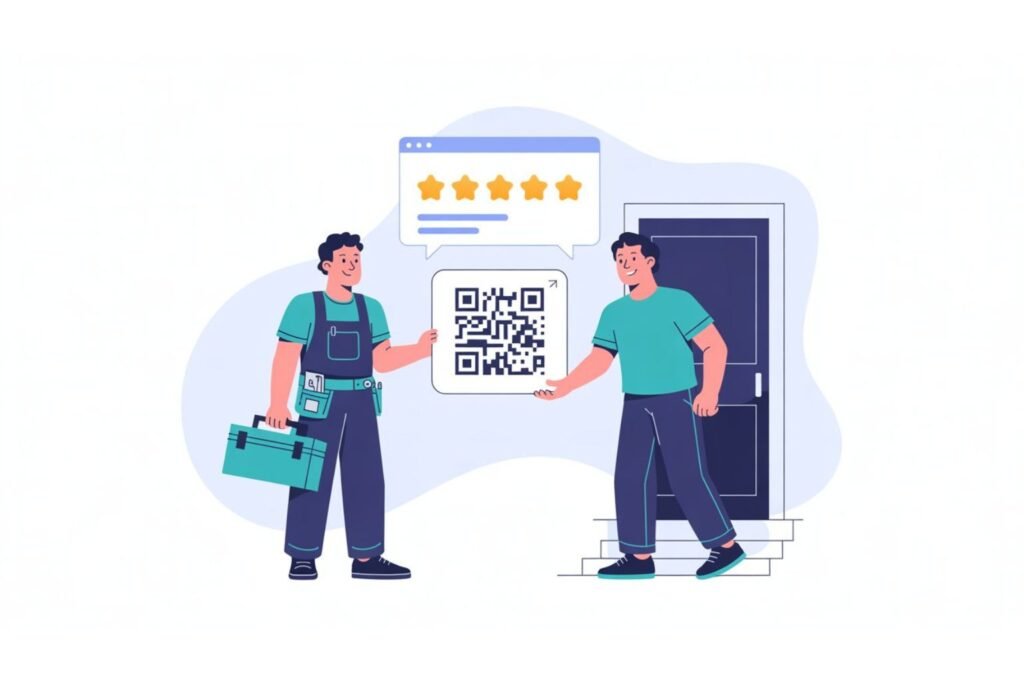
A contractor with 4.9 stars and 38 reviews loses their 3-pack position to a competitor rated 4.6 with 190 reviews. The lower-rated company wins more calls, charges higher prices, and books further out. The better-rated contractor wonders why their phone is slower.
The answer isn’t the star rating. It’s review volume — and, more importantly, how recently those reviews arrived.
An effective HVAC review strategy is the system that keeps new reviews arriving consistently: a repeatable ask process, automation that runs during your busiest weeks, a seasonal plan that prevents velocity drops between peaks, and a response framework that turns your public replies into a sales tool. This guide covers all four.
Google reads a review profile the way you’d read a performance record—recent activity carries more weight than history. A contractor who collected 80 reviews in 2022 and has gone quiet since looks like a business that slowed down. Google surfaces them less. Customers who do find them see a wall of old reviews and wonder if the company still operates the same way.
This is one piece of a broader HVAC local SEO strategy—the full guide covers how reviews connect to Google Business Profile optimization, citation building, and service area content.
Why review volume and recency matter more than your star rating
The short answer: Google’s local algorithm weights review recency heavily. A profile adding six to eight reviews per month signals an active, engaged business. A profile with 80 stale reviews signals one that has slowed down—even if those reviews are glowing. Volume and velocity drive 3-pack placement. Star rating affects conversion after the click.
Most contractors focus on the number next to the stars. That’s not the wrong thing to focus on, but it’s not the whole picture.
Google’s local algorithm evaluates businesses on three signals: relevance (do you do what the person searched for), distance (how close are you), and prominence (how credible and active does Google think you are). Reviews are the primary input into prominence. But within that signal, Google doesn’t just count reviews — it weighs them by how recently they arrived.
A profile adding six to eight reviews per month tells Google’s systems: this business is active, customers are engaging with it, and it’s worth surfacing for people searching nearby. A profile that collected 80 reviews two years ago and has received none since tells a different story — even if those 80 reviews are glowing.
In practical terms, the thresholds that hold in real US, UK, and Canadian markets are the following:
- 25 reviews — where most consumers start taking a profile seriously
- 50+ reviews — competitive floor in mid-sized markets
- 100+ reviews — the level at which you’re genuinely difficult to displace in most cities
- 200+ reviews—what the sustained 3-Pack holders typically carry in dense metros like Houston, Dallas, or Toronto
More than the total count, businesses maintaining five to twelve new reviews per month and a rating above 4.5 consistently hold position over competitors with larger but stagnant profiles.
There’s a secondary effect worth building into your thinking: review strength directly affects what you can charge. A contractor rated 4.8 with 150 recent reviews can price a furnace replacement $300–500 higher than an equivalent competitor rated 4.2 and still win the job. The customer doesn’t consciously do that math — but the trust signal built into a strong review profile removes the price sensitivity that a weaker profile creates. Your review strategy is also your pricing strategy, and it feeds directly into HVAC lead generation by increasing conversion rates from every channel that drives profile views.
The five-step ask system that produces consistent reviews
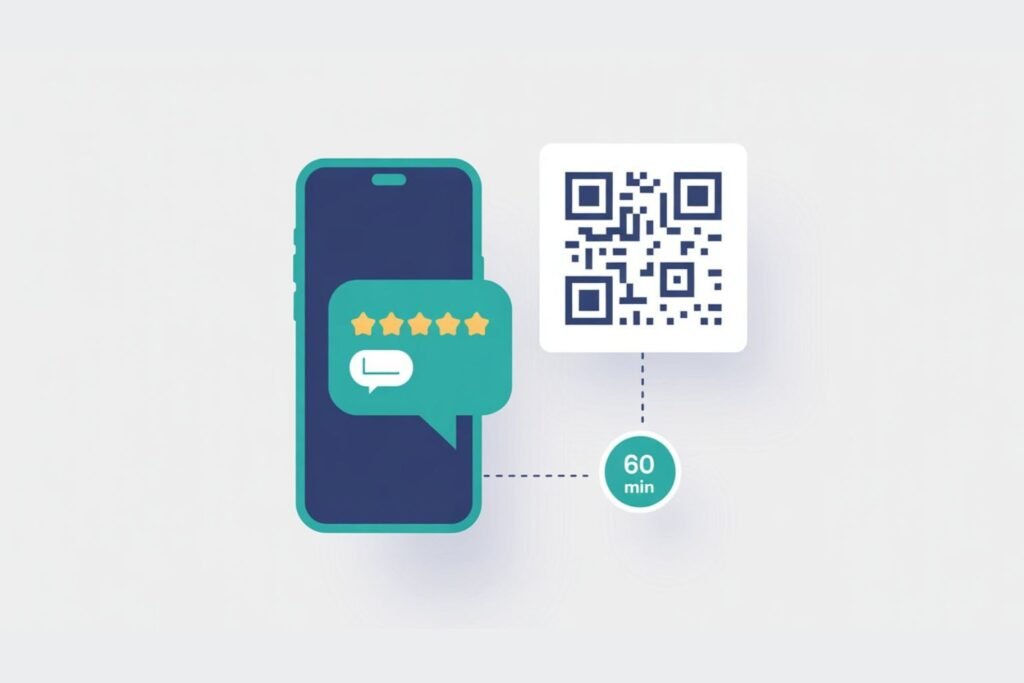
How do you ask HVAC customers for a Google review? The answer that actually works: a five-step sequence where the ask is built into the job process rather than left to the technician’s memory.
The difference between contractors who accumulate reviews steadily and those who collect them in bursts isn’t how good the service is. It’s about whether the ask is built into the job process or left to chance.
A technician who finishes a job, feels satisfied with the work, and thinks “I should mention the review thing” is operating on memory. Memory fails at 4:30 pm on the fourth job of a Tuesday in July. A documented sequence doesn’t.
Step 1 — The in-person setup
Before your technician leaves, they say one sentence. Not a pitch. One sentence:
“If everything looks good, we’d really appreciate a Google review — I’ll text you the link in a few minutes.”
The phrase “in a few minutes” does two things: it sets an expectation so the text doesn’t arrive cold, and it commits the technician to actually sending it. It also frames the review as a favor from a satisfied customer, not a marketing request from a company. That framing matters more than most people realize.
When not to do the verbal ask: any job with unresolved complaints, pricing friction, a callback situation, or a customer who seemed dissatisfied at any point. Those situations need resolution before a review request is anywhere near appropriate. Sending a review link to a customer who’s already unhappy doesn’t produce a one-star review — it accelerates one.
Step 2 — SMS within 60 minutes
SMS is the only channel where near-certain delivery meets near-certain open rate. Emails get filtered, forgotten, or buried under promotions. A text sent within an hour of job close reaches the customer while the relief of a working AC or a fixed furnace is still fresh. That emotional window is real — and it closes faster than most business owners expect.
The template that consistently works, kept under 160 characters:
Hi [First Name], thanks for choosing [Company Name] today! If you have 2 minutes, a Google review really helps us. [Short link] — [Tech Name]
Two specifics that meaningfully lift response rate: the customer’s first name (personalization signals this isn’t mass marketing) and signing with the technician’s name rather than the company name (it keeps the connection to the actual person who did the work). Both feel like small details. In practice, they’re the difference between a message that reads like a human sent it and one that reads like software.
To build your review link: open your Google Business Profile, go to Home, find “Get more reviews,” and copy the URL. Run it through a bit. ly or your own short domain before loading it into templates—the raw Google URL is long enough to look like spam.
Step 3 — Email at 48 hours
Some customers open the text, click the link, and abandon it halfway through—they get distracted, the phone rings, or the kid needs something. A single follow-up email two days later catches a portion of that group.
Subject line: A quick follow-up on your recent service
Body (keep it short):
Hi [First Name], just checking in after the [service type] we completed [day]. Hope everything is running well. If you have a spare moment, a Google review genuinely helps our team and makes it easier for neighbours to find a reliable local contractor. [Link]
Stop after two messages. Three is where you cross from persistent to annoying, and annoyed customers don’t leave good reviews.
Step 4 — QR code cards at handoff
A small card — business card size, laminated — with a QR code pointing to your Google review page. Technicians hand it over when they collect payment or leave it on the counter when the homeowner isn’t available to sign off in person.
Some customers, especially older ones, won’t click a link from an unknown number. But they will scan a code from a physical card with your logo on it. The card also serves as a lasting reminder that the text doesn’t; it sits on the counter until someone picks it up. Cheap to print. Easy to produce. Most contractors skip it because it feels low-tech.
Step 5 — Guide the content of the review
Google’s terms of service prohibit incentivising reviews. They do not prohibit guiding customers on what to write. There’s a significant practical difference between the two.
When the technician makes the verbal ask, they can add: “If you mention the work we did and your area, that really helps people find us when they need the same thing.”
That one sentence shifts reviews from “great company, highly recommend”—which carries minimal local search signal—to “fixed our furnace in [city], came same day, fair price”—which tells Google exactly who you are, what you do, and where you do it. You’re not asking them to say anything untrue. You’re helping a satisfied customer write something useful.
Removing the human memory variable: automation inside your software
The ask sequence above works. It works better when no one has to remember to run it.
During summer peak season, a technician running six calls a day is thinking about the next job, not about following up with the last customer. Manual review requests collapse under that kind of volume, which is precisely when you have the most review opportunity. Automation solves that contradiction.
How to set it up in ServiceTitan and Housecall Pro
Both platforms support triggered messaging off job status changes. The setup:
- Trigger: job status moves to “Completed” or “Invoiced”
- Delay: 30–60 minutes
- Action: fire the SMS template with the review link
- Second action: fire the email follow-up 48 hours later if no response
That’s the whole workflow. Once it’s live, every completed job automatically produces a review request—regardless of whether the technician remembered or regardless of how many jobs they ran that day. Companies that automate this collect roughly three times the review volume of those running manual processes, and they do it without adding workload to the field team.
When to bring in a dedicated reputation tool
Your FSM automation handles the basics well. Gaps appear when you need multi-platform routing (Google, Yelp, and Facebook based on the customer’s preferences), response management at scale, or detailed analytics on conversion rates by technician or service type.
For most single-location contractors, the choice is straightforward: NiceJob is for service businesses under $5M that want a purpose-built tool that integrates with most FSMs in under an hour. BirdEye for multi-location operators who need one dashboard across platforms—heavier setup, higher cost, broader scope. GoHighLevel if you’re already running it as your CRM and want review workflows as part of an existing stack rather than a separate tool.
The goal isn’t sophisticated tooling. It’s removing the dependency on anyone remembering to ask.
The seasonal problem most contractors never solve

HVAC call volume follows a predictable curve. Summer AC season, winter heating season, and two quieter shoulders in spring and fall. Most contractors’ review profiles follow exactly the same curve, which is precisely the problem.
Google’s recency weighting means that if your review velocity drops for 60–90 days, your local rankings erode during that period. By the time May rolls around and AC season kicks in, you’ve spent two months with a weakening profile. You enter peak season ranked below where you were in March. You earn reviews through June and July and recover — then fall again in September.
Breaking that cycle requires treating each season differently:
Summer (June–August) — peak job volume is your biggest review window. Let automation carry it. Your target here is 10–15 new reviews per month. Don’t ask technicians to manage it manually; they’re running too fast, and every missed ask is a wasted opportunity from a customer who would have happily written something.
Fall (September–October) — volume drops and the temptation is to let the review cadence drop with it. Instead, run a four-week technician contest. A leaderboard showing which tech has generated the most reviews that month, visible in the break room or on the group chat, costs nothing to set up. The critical compliance point: reward the asked behavior—not the review itself. A $25 bonus for every verified review linked to a technician’s jobs is compliant. “Earn $25 for every 5-star review” is not true. Keep the target at five to eight reviews per month during fall.
Winter (November–January)—heating season produces a natural second peak. Same automation approach as summer. The difference from spring/fall is volume, not process.
Spring (February–April) — the hardest quarter. Low call volume, six to eight weeks before AC demand arrives. This is where a re-engagement campaign earns its keep: a short email to customers from the previous 12 months who never left a review. No incentive, no pressure — just a brief message from the owner reminding them that a review would mean a lot to the team. Even a 5% conversion rate on a list of 200 past customers puts 10 reviews into a quarter when most competitors are collecting almost none.
The overall goal is never to manufacture reviews. It’s to ensure that every satisfied customer who would have left a review if asked at the right moment actually does. Most of them don’t because the moment passed before anyone asked.
How to respond — and the five habits that quietly destroy trust
Review responses are read by prospective customers, not just the person who left the review. When someone is evaluating two contractors and reads through both profiles, the response behavior is often what tips the decision. A contractor who responds to a one-star review with “we went above and beyond; the customer was unreasonable” loses that comparison every time, regardless of how legitimate the complaint was.
Responding to positive reviews
Keep responses short, specific, and varied. Three sentences maximum. Name the technician when they were mentioned. Reference the service type and city when it fits without sounding manufactured.
AC repair:
Thank you, [Name]—glad [Tech Name] got the system sorted quickly. Those calls in July are never fun to receive, and it matters to us that we can show up fast when it counts. Really appreciate you taking the time.
Furnace installation:
Appreciate this, [Name]. A furnace install before winter is one of those jobs we want to get right the first time—sounds like [Tech Name] delivered. Thanks for trusting us with it.
Maintenance visit:
Great to hear, [Name]. Preventive maintenance is exactly the kind of job where the value isn’t always obvious until you avoid the emergency call in February. We’ll see you next season.
Rotate the structure. A profile where every response starts with “Thank you for your kind review; we strive for excellence” reads as unattended and suggests the reviews themselves aren’t being read.
Negative reviews: different complaints need different responses
Pricing complaint: Don’t defend the rate in public. You won’t win, and anyone reading will watch you try. Acknowledge it and offer to talk privately: “We understand pricing matters—this is worth a direct conversation. Please call us at [number] so we can walk through the invoice together.”
Service failure or callback: Apologize without conditions. Don’t reference the technician’s perspective, the difficulty of the job, or the age of the customer’s equipment. “This isn’t the experience we aim for. Please contact me directly at [email] [phone number]—I’d like to personally understand what happened and make it right.”
Response time: Own it if it’s accurate. Customers who complain about wait times on a 95-degree July day aren’t being unreasonable. “You’re right that our response time on this call didn’t meet the standard we hold ourselves to. I’d like to speak with you directly.”
Safety incident: Escalate to owner response immediately. This is not a situation for the dispatcher or marketing manager to handle. Name the seriousness directly: “A report like this is something I take personally.” Please contact me at [direct number]—your family’s safety is the priority here, and I need to understand what happened.”
The five habits that erode your reputation faster than bad reviews do
Incentivizing reviews with discounts or gift cards. Beyond the Google profile suspension risk, it produces a skewed review set that customers notice — a wall of five-star reviews with suspiciously similar language. The FTC has taken enforcement action against businesses in exactly this category.
Responding defensively to negative reviews. The customer who left the review is already gone. You’re writing for the next hundred people who read that exchange. Write for them.
Using identical positive review responses. Copy-paste responses across twenty reviews signal to Google and to readers that no one is actually paying attention. Google can detect response duplication, and it depresses engagement signals.
Ignoring platforms outside Google. Yelp matters in California and major metros. Angi matters for homeowners who research before price-checking. BBB matters for commercial customers and in Canadian markets particularly. A strong Google profile next to a blank or three-star A Yelp listing creates a credibility question that costs you jobs.
Letting 48 hours pass before the review request goes out. A request sent three days after the job converts at roughly half the rate of a same-day text. The emotional context—relief, satisfaction, and the memory of how the technician handled a difficult situation—fades quickly. The window is real, and it’s short.
FAQ
How do I ask HVAC customers for a Google review without it feeling pushy?
The framing that works is a favor, not a marketing request. The technician’s one-sentence verbal ask—”If everything looks good, we’d really appreciate a Google review—I’ll text you the link in a few minutes”—followed by a timely SMS is the complete system. The text commits the technician to follow through and primes the customer so the message doesn’t arrive cold. Keep the SMS under 160 characters, use the customer’s first name, sign with the technician’s name, and send it within 60 minutes of the job close. That’s it. No scripts, no pressure, no incentives needed.
How many Google reviews does an HVAC company need?
The benchmarks that hold in real markets: 25 reviews to pass the basic credibility threshold with most consumers, 50+ to compete in mid-sized cities, 100+ to hold position in denser markets, and 200+ in major metros where the 3-pack is highly contested. Total count matters less than whether you’re adding 5–12 reviews per month—a profile with steady velocity and 70 reviews will frequently outrank a stagnant profile with 140.
What is review velocity and why does it matter for HVAC local SEO?
Review velocity is the rate at which new reviews arrive on your profile over time. Google interprets consistent incoming reviews as evidence of an active, engaged business—which feeds the prominence signal that influences 3-pack placement. A contractor adding 6–8 reviews per month will hold or improve rankings. A contractor whose last review was four months ago will see rankings erode, often heading into peak season when the timing is worst.
Can I offer a discount to customers in exchange for leaving an HVAC review?
No — and the risk is higher than most contractors realise. Incentivising reviews violates Google’s terms of service and the FTC’s endorsement guidelines. Google can demote or suspend profiles where incentivised reviews are detected. The compliant alternative — a timely, frictionless ask — produces more review volume than any incentive program, without the liability.
Which review platforms should HVAC contractors focus on first?
Google is the clear priority because it directly influences your GBP ranking, 3-Pack position, and Local Services Ads quality score. Once you’re consistently adding Google reviews, build Yelp—particularly relevant in California, major US metros, and urban UK markets. Angi matters for homeowners who research before committing. BBB carries more weight in Canada and for commercial HVAC work than for standard residential service.
How do I handle a fake or competitor-posted HVAC review?
Flag it via the GBP dashboard (“Flag as inappropriate”) and document the evidence—no customer record, impossible service date, suspicious reviewer history. While Google investigates, respond publicly once, calmly: “We have no record of this customer or job in our system and have flagged this review for Google to investigate.” We take all genuine feedback seriously.” One response. Don’t engage further — continued responses keep the review visible in activity feeds.
Does a 4.5 vs. 4.8 star rating actually affect how many jobs I win?
Yes, and the effect is compounding rather than linear. A rating above 4.7 correlates with higher conversion rates from profile views to phone calls, higher average job values (customers are less price-sensitive when they trust the contractor), and better performance in Local Services Ads, where Google uses review quality as part of ad rank. The practical priority is protecting the rating you have—one unresolved complaint that turns into a public one-star response costs more leads than ten positive reviews recover.
Your 30-day setup checklist
You don’t need all of this live on day one. This sequence builds the system in a logical order, each week depending on what the previous week put in place.
Week 1: Get your Google review short link from the GBP dashboard. Write your SMS template. Create a QR code at qr-code-generator.com or similar. Send the card design to print. None of this should take more than two hours.
Week 2: Configure the automated trigger in ServiceTitan, Housecall Pro, or your CRM. Load the SMS and email templates. Test it on three completed jobs yourself before it goes live for the whole team.
Week 3: Brief your technicians on the one-sentence verbal ask. Be specific about when not to use it—unresolved complaints, pricing disputes, and visible frustration. Role-play it once in a team meeting so it doesn’t feel awkward in the field.
Week 4: Put the response templates into a shared Google Doc or internal wiki. Assign one person to own review responses with a 24-hour turnaround SLA. Make it someone’s actual responsibility, not everyone’s vague responsibility.
Ongoing: Check your review velocity at the end of every month. If you’re below five new reviews, that’s the trigger to run a technician contest or send a re-engagement email to previous customers. Review your seasonal plan at the start of Q2 (before AC season) and Q4 (before heating season).
A contractor who runs this consistently for twelve months builds a profile that is genuinely difficult to displace—not because any single component is sophisticated, but because the accumulated recency, volume, and response engagement create a ranking signal that compounds over time. A competitor who starts the same effort a year later is starting from zero while you’re already holding the position.
For how reviews feed into your broader Google Maps ranking system—including GBP setup, citation building, and service area pages—the HVAC local SEO guide covers the full picture. For how a strong review profile connects to your paid search performance, HVAC lead generation strategy, and HVAC digital marketing overall, those guides cover the full funnel.