Most HVAC companies rank #1 near their shop and nowhere else. The best HVAC local SEO tools fix that rank tracking, citation cleanup, and GBP management in the right order.
The Best HVAC Local SEO Tools in 2026 (Ranked by What They Actually Fix)
You’re ranking #1 in your own zip code. Your phone rings regularly. Meanwhile, a homeowner three miles north needs an emergency AC repair on a Saturday. They search, your competitor picks up the call, and you never even knew it was there.
That’s not a marketing problem. It’s a visibility gap, and it exists in almost every HVAC company’s service area, whether they know it or not. The best HVAC local SEO tools fall into three categories: rank visibility, citation management, and GBP and review growth. The right tools don’t just tell you your ranking; they show you the exact shape of the gap. That’s where this guide starts.
One framing note before the tools: this isn’t a list you buy all at once. The tools here are organized as a stack with a sequence see what’s actually happening, fix what’s broken, then invest in growth. Starting in any other order is how you spend $200/month on software and wonder why nothing moved.
Your Rankings Aren’t What You Think They Are
Most HVAC businesses check their ranking by Googling themselves from their shop’s address. That tells you almost nothing useful.
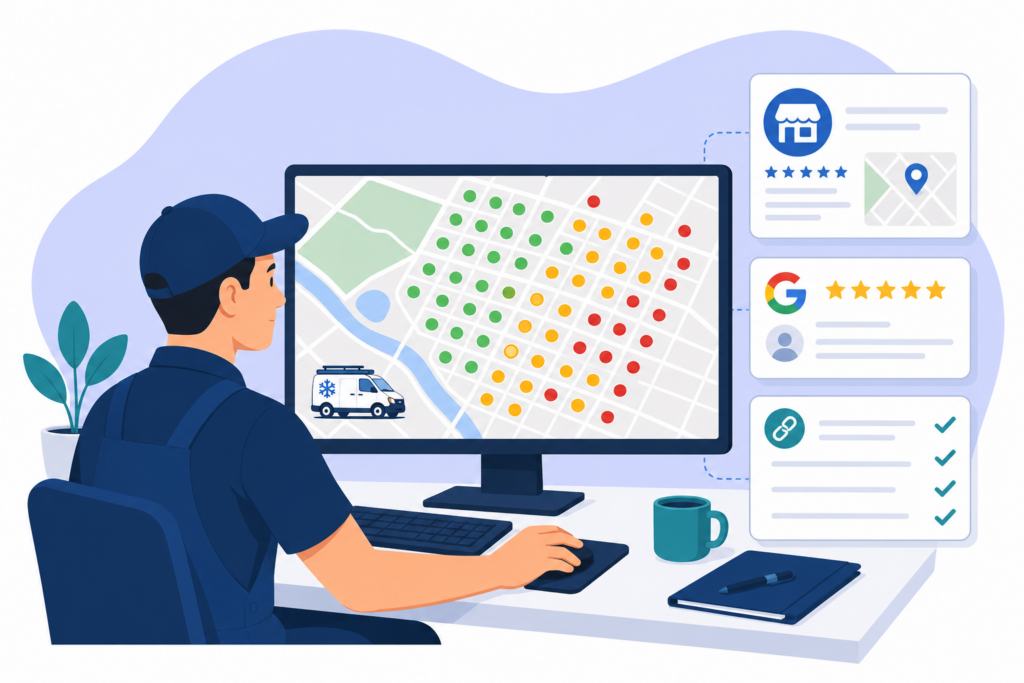
Your Google Maps ranking and your position in the Local Pack, the three-business map result that captures the majority of local clicks, change block by block. You might rank #2 at your own address, #6 two miles east, and #14 at the edge of your service territory all for the same keyword, all at the same time. Inside that invisible patchwork are the neighborhoods where you should be winning work but aren’t.
The stakes are higher in HVAC than most service categories because of emergency intent. When a furnace stops working at midnight in January, no one comparison shops. They call whoever appears first and looks credible. If your map listing doesn’t surface in a neighborhood you serve, that job doesn’t exist for you; you never even get the chance to lose it on price.
General SEO platforms like Semrush or Ahrefs are built for organic search analysis. They won’t show you how your Google Maps ranking shifts block by block across a service territory. The tools below are built for exactly that problem and for the citation and GBP issues that drive it.
This is why the tool stack below starts with visibility, not optimization. You can’t fix what you can’t see.
Stage 1: See Where You Actually Rank
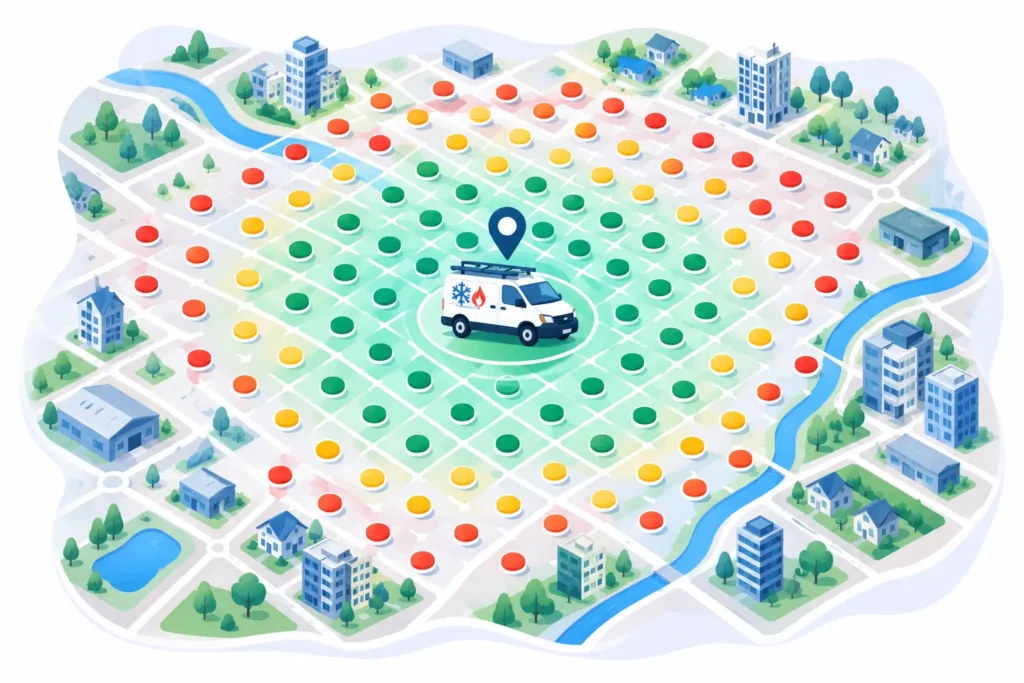
What is a GeoGrid for HVAC local SEO? A GeoGrid is a map that shows your Google Maps ranking position at dozens of GPS coordinates across your service area simultaneously. Rather than knowing you rank “#4 for AC repair,” you can see that you rank #2 at your shop’s address, #6 two miles east, and #14 near the school district on the far side of your service territory all in a single scan. For any HVAC company covering more than a few zip codes, this is the most honest ranking data you can get.
Local Falcon
Local Falcon is built for exactly this. You enter your business name and a keyword “HVAC repair,” “furnace installation,” or “AC tune-up,” set a grid size and radius, and it returns a color-coded map of your service area: green for top-3 positions, yellow for 4–10, and red for 11 and below.
What makes it specifically useful for HVAC is the before/after comparison. Run a scan in early March before you push seasonal content. Run the same scan in late May. Now you can see which neighborhoods responded to the work and which didn’t move—not a general ranking trend, but a geographic one. That’s the kind of feedback that tells you whether to write another service page for a specific suburb or whether the issue is something deeper like citation inconsistencies in that zip code.
Local Falcon is a read-only tool; it diagnoses, it doesn’t treat. Pricing runs around $24.99/month. A scan takes under five minutes once you know what you’re doing. The one thing it won’t tell you is why your ranking is what it is in a given spot. For that, you need the rest of the stack.
BrightLocal (Rank Tracking Module)
BrightLocal does geo-based ranking work similar to Local Falcon, but it’s built for people who need more than a map. The surrounding platform covers GBP analytics, citation health, and review monitoring, which means if you’re a marketing manager reporting to an HVAC owner quarterly, you can pull a single report showing ranking movement, GBP impression trends, review velocity, and citation status. That’s the accountability document that either keeps your budget intact or tells you exactly where to redirect effort.
For pure rank visualization, Local Falcon is sharper. For a consolidated view of everything affecting your local presence, BrightLocal earns its $39/month starting price. The two tools aren’t redundant; plenty of HVAC marketing managers run both.
→ The ranking data these tools surface is only as useful as the GBP profile it’s measuring. A fully optimized HVAC Google Business Profile is the foundation both tools assume you have.
Stage 2: Fix What’s Broken
Once you can see your ranking gaps, the next question is what’s causing them. In most cases, especially in neighborhoods more than five miles from your shop, the answer is citation inconsistency.
Citation data is how Google cross-references your business across the web. When your name, address, and phone number appear differently across Yelp, Angi, HomeAdvisor, Thumbtack, and a hundred smaller directories, Google’s confidence in your business location drops. That drop shows up in your Local Pack rankings, and it almost always hits hardest at the edges of your service area, not at your own address.
HVAC companies accumulate citation drift faster than most service businesses. You moved the shop three years ago. You changed your number when you switched providers. You rebranded from “Smith Heating & Air” to “Smith HVAC Solutions.” Each of those changes, unless you systematically updated every directory, left a trail of conflicting signals that’s still suppressing your visibility today.
The rule: fix citations before you spend anything on content or tracking upgrades. You can’t track your way out of a citation problem.
Whitespark Citation Finder
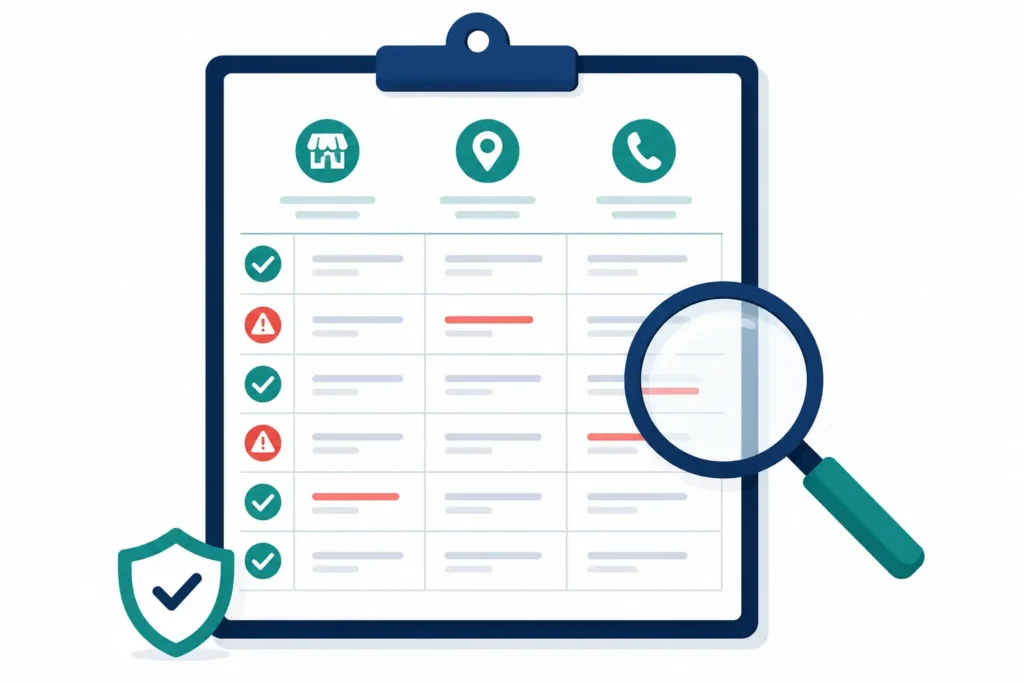
Whitespark’s Citation Finder does the audit first: it shows you every directory where your HVAC business is currently listed, flags NAP inconsistencies, and identifies high-authority directories in your category where you should appear but don’t.
Here’s what that audit typically surfaces for an HVAC company that’s been operating for five-plus years: the old address is still live on a dozen contractor directories, the previous phone number is still attached to your Yelp listing, and the business name is spelled three different ways across utility company vendor pages and local chamber sites. None of those discrepancies feel significant in isolation. Together, they’re telling Google a different story about who and where you are.
The manual citation-building service is the other reason HVAC owners choose Whitespark specifically: a real person submits your corrected information, and you own those listings permanently. No subscription required to keep them live. For multi-location HVAC operations, build a master spreadsheet, assign each location an owner, and run a Whitespark audit every time something changes address, phone, name, or ownership.
Pricing for the finder tool starts around $25/month. UK operators: add Checkatrade, Bark.com, and TrustATrader to your priority list alongside the standard directories.
→ The full HVAC citation building checklist covers every priority platform with specifics on UK and Canadian markets.
Moz Local
For a single-location HVAC owner who doesn’t want to manage citations manually, Moz Local handles distribution to approximately 70 directories automatically. You submit your NAP data once; Moz Local pushes it out and monitors for drift.
The honest trade-off: you don’t own the listings the same way you do with Whitespark’s manual service. If you cancel your subscription, some directories may revert or go unmanaged over time. For an owner who’s never done a citation audit and needs to establish a clean baseline across the major directories quickly, Moz Local at $20/month is the most efficient entry point. For someone who wants permanent, precise control, especially after a business change that requires widespread correction, Whitespark’s manual approach is worth the extra work.
In practice, these tools complement each other: Whitespark for the critical, high-authority corrections and Moz Local for ongoing automated maintenance across the mid-tier directories.
Stage 3: Grow Visibility and Reputation
A clean citation foundation and accurate ranking picture give you a stable baseline. Stage 3 is where you build on it, compounding your GBP presence, review volume, and organic content performance over time.
BrightLocal (Full Platform)
The full BrightLocal platform adds review generation and monitoring to the ranking and citation features. For HVAC, this matters in a specific way: Google’s local algorithm doesn’t just count reviews; it reads the pace at which they arrive. A business generating 15 genuine reviews per month consistently outranks one that collected 200 reviews in a two-week push two years ago. Sustained velocity beats volume.
BrightLocal’s review request tool sends automated follow-ups via SMS and email after a job closes. For a company running 40–80 service calls per month, a 20% response rate on those requests generates enough consistent review activity to move your rating within a quarter.
The feature that most HVAC businesses don’t use: the GBP post scheduler. During your slow months, October through February, in most US markets, you can pre-write and schedule your spring tune-up, AC season prep, and summer heat advisory posts in advance. They go live when they’re relevant, even if you’re deep in heating season and haven’t thought about content in weeks.
→ Review generation is a system, not a campaign. The HVAC review strategy guide covers how to build it into your service workflow without adding admin overhead.
Google Search Console (Free)
This tool appears in almost no HVAC local SEO roundup, which is its entire recommendation right there.
Google Search Console is already connected to your website if you’ve done basic setup, and it contains search data that most HVAC companies have never looked at. Go to Performance → Search results → Queries. Filter by your service area. Sort by position.
What you’ll find in most HVAC company accounts: a cluster of queries like “furnace repair [your city],” “HVAC service near [neighborhood],” or “AC compressor replacement [zip code]” sitting at positions 8–15 in organic search. Not page 3, positions 8 through 15. One well-built service page targeting those queries specifically can move several of them into the top 5 within 60–90 days. That’s traffic with high commercial intent that’s one content update away from landing in your lap.
No paid subscription. No learning curve once you find the right report. The data is already yours.
→ The queries GSC surfaces map directly to the service area page structure covered in the HVAC service area pages guide.
The HVAC Local SEO Tool Stack, by Stage and Budget
There’s no single best tool for HVAC local SEO. The useful answer is: Which tools solve your current problem, in what order, and at what cost?
| Starter Stack | Growth Stack | |
|---|---|---|
| Best for | Solo owner, one market, DIY | Marketing manager, multi-location, or agency oversight |
| Monthly cost | ~$45–70 | ~$130–185 |
| Rank visibility | Local Falcon ($25) | Local Falcon + BrightLocal |
| Citations | Moz Local ($20) | Whitespark ($25) + Moz Local ($20) |
| GBP + Reviews | GBP Insights (free) + GSC (free) | BrightLocal full platform ($39+) |
| Call attribution | — | CallRail ($45+) |
An average HVAC job in the US runs $300–$500. A tool stack that surfaces and helps you win two additional jobs per month pays for itself before the second week of billing. The question has never been whether these tools are worth the cost; it’s whether you’re sequencing them correctly.
One use case most HVAC owners haven’t considered: if you’re paying an SEO agency, this same stack functions as an independent audit. Local Falcon shows whether your map pack rankings are actually moving. BrightLocal tells you whether citation health is improving. GSC shows whether the content they’re publishing is generating organic traffic. You don’t need to do the optimization work yourself to benefit from seeing the data; you just need to know which numbers to ask about.
Three Mistakes That Keep HVAC Tools from Working
Buying Tools Before Auditing Citations
Rank tracking is useless if NAP inconsistencies are suppressing your visibility. A tool that shows you stuck at position #12 can’t tell you whether that’s a content gap or a citation problem. Run the Whitespark audit first. Then track.
Treating Local Falcon as a Report Card Instead of a Diagnostic
A single scan tells you your position. It says nothing about whether you’re moving. The value is in running the same scan with the same keyword, same grid, and same radius before and after a specific change. New service page, citation cleanup sprint, GBP post push. That comparison is the tool.
Skipping Google Search Console Because the Interface Looks Intimidating
You don’t need 90% of what’s in there. Performance → Queries → filter by location → sort by position. That’s the report. Fifteen minutes once a month, and you’ll know exactly which organic keywords are one service page away from generating calls. No paid subscription, no agency, no guesswork.
Frequently Asked Questions
What is the best local SEO tool for HVAC companies?
No single tool covers everything well. The strongest approach is a stack: Local Falcon for geographic rank visibility, Whitespark or Moz Local for citation cleanup, and BrightLocal’s full platform for GBP management and review generation. Sequence matters: diagnosis before treatment, citations before content investment.
What is a GeoGrid, and why does it matter for HVAC?
A GeoGrid maps your Google Maps ranking at dozens of GPS points across your service area simultaneously. It reveals that your position near your shop’s address (usually strong) and your position two miles away (often much weaker) are two different rankings. For HVAC companies serving a 15–30 mile radius, that gap is where most of the invisible lost revenue lives.
How much do HVAC local SEO tools cost per month?
A starter stack, Local Falcon and Moz Local, plus the free tools Google already gives you, runs $45–50/month. A full growth stack with BrightLocal, Whitespark, and call tracking runs $130–185/month. Either way, capturing two additional service calls per month at a $350 average ticket covers the entire monthly cost.
Can I manage HVAC local SEO without an agency using these tools?
For a single-location business in one market, yes, and the time investment once the stack is set up is roughly two to four hours per month. The more pointed question: Is your time worth more running the business? If yes, the same tool stack lets you hold an agency accountable to actual ranking and lead data rather than activity reports.
What’s the difference between BrightLocal and Local Falcon for HVAC?
Local Falcon does one thing: geographic rank tracking via GeoGrid, and it does it cleanly. BrightLocal wraps similar tracking inside a full platform covering citations, GBP analytics, review requests, and reporting. For rank visualization only, Local Falcon is the sharper tool. For a single dashboard covering most of your local SEO operation, BrightLocal is the stronger long-term investment.
Is BrightLocal worth it for a small HVAC company?
For a solo operator running one location, the full BrightLocal platform ($39+/month) is likely more than you need at the start. Begin with Local Falcon for rank visibility and Moz Local for citation coverage; that starter stack runs under $50/month and covers the two highest-impact problems. Upgrade to BrightLocal’s full platform when you’re actively working on review velocity or need a consolidated report for a business partner or lender.
Start Here
Run a local Falcon GeoGrid scan on your primary service area. Set a 15-mile radius, use “HVAC repair” or your highest-value service keyword, and look at the result honestly. Most HVAC owners who do this for the first time find two or three neighborhoods where they’re below position 7 areas they actively serve, customers they never reach.
That scan is free to try and takes five minutes. What it shows you will tell you which stage of this stack you actually need right now.
For the broader strategy these tools support, the HVAC local SEO guide covers the full picture. For how local SEO connects to your paid channels, content, and website, the HVAC digital marketing guide is where that conversation continues.