
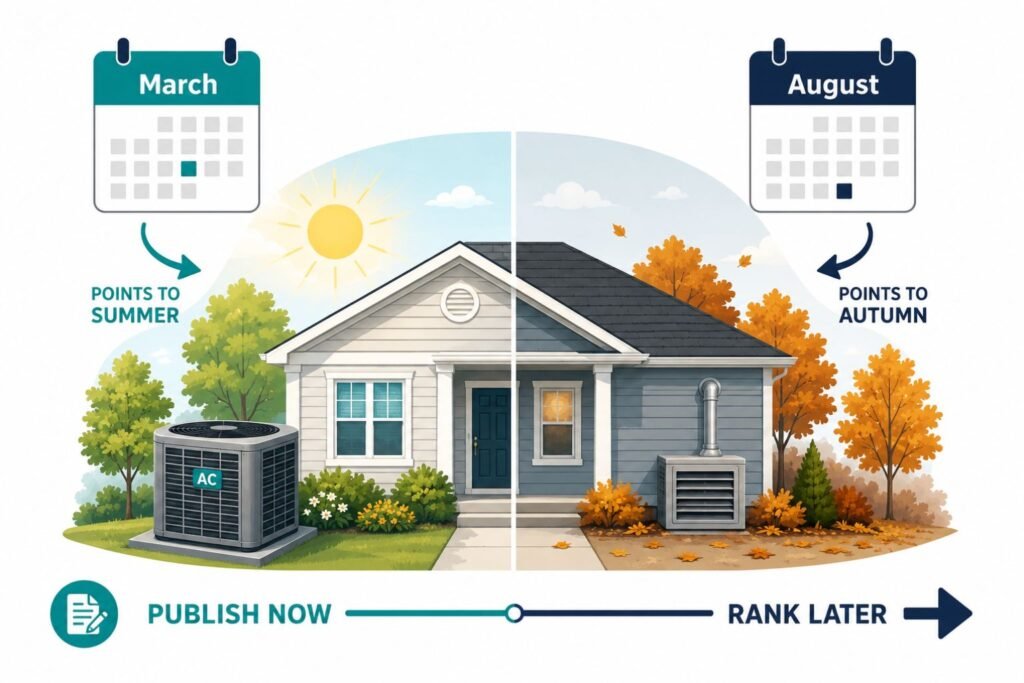
Most HVAC companies don’t lose peak-season rankings because they ignore SEO. They lose them because they start in the wrong month. Publishing an AC repair guide in June feels logical; peak demand is here, and the phones are ringing. But Google needed 60 to 90 days to index and rank that page. By the time it appears, it’s August. The season is nearly over.
The contractors who answer every call in July started publishing in January.
This is a month-by-month HVAC seasonal SEO calendar: what content to publish, when to update your Google Business Profile, and when to push reviews all timed to the actual demand windows that drive calls. It’s one focused piece of a larger HVAC local SEO system; everything here is about timing alone.
Why the 60–90 Day Indexing Window Changes Everything for HVAC
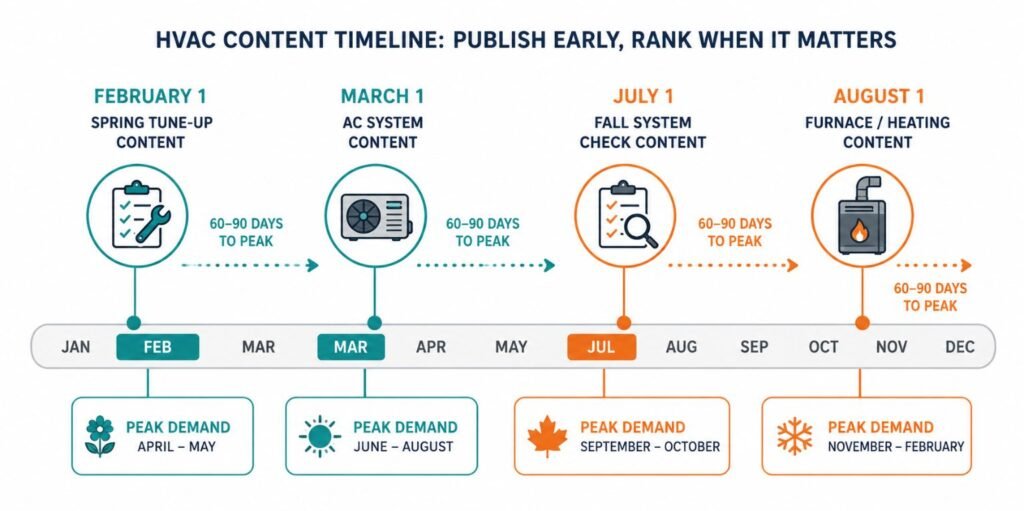
Google doesn’t rank pages the moment they go live. A new or meaningfully updated page has to be crawled, indexed, and evaluated for relevance — a process that typically takes 60 to 90 days before stable rankings settle in. For an e-commerce store selling year-round products, that lag is a minor inconvenience. For an HVAC contractor, it’s the difference between a fully booked season and a quiet one.
HVAC search volume swings 300 to 500 percent between peak and off-peak months—you can verify this yourself by opening Google Trends, searching “AC repair” and “furnace repair” on the same chart, and switching to the 5-year view. The two peaks barely overlap. “AC repair near me” surges from May through August. “Furnace repair near me” spikes from October through January. These aren’t gradual climbs — they’re sharp, short windows. A homeowner’s AC dies on a Thursday afternoon in July. They search, they call whoever comes up first, and they move on with their day. If your page isn’t ranking by May, the July caller never finds you.
One note on heat pumps: they serve both heating and cooling, so contractors whose markets run primarily on heat pumps are essentially managing two overlapping seasonal calendars for the same equipment. Heat pump cooling content follows the March 1 deadline; heat pump heating content follows August 1. Both apply.
HVAC Content Publish Deadlines by Season
Work backwards from the demand peak, not forward from when you feel like writing.
| Season | Peak demand months | Content must be live by |
|---|---|---|
| Cooling (AC, air quality, duct cleaning) | May – August | March 1 |
| Heating (furnace, heat pump, boiler) | October – January | August 1 |
| Spring tune-up | April – May | February 1 |
| Fall system check | September – October | July 1 |
Miss those dates and the pages won’t rank for the peak that follows. This is the only logic that matters when building the calendar below.
The 12-Month HVAC SEO Calendar
Use the table as a quick reference. The quarterly breakdowns below it explain what each window actually requires in practice.
| Month | Content focus | Example keyword targets | GBP action | Review priority |
|---|---|---|---|---|
| January | AC replacement, air quality, spring landing pages | “AC replacement cost [city],” “indoor air quality improvement” | Winter safety tips, system check CTA | Low — collect from December jobs |
| February | Spring tune-up, pre-season AC pages | “spring AC tune-up near me” and “AC maintenance checklist” | Spring service teaser post | Medium—follow up winter jobs |
| March | Cooling content must be live | “AC repair near me,” “central air installation cost” | Spring AC service post + seasonal photo | Medium |
| April | Location pages, diagnostic guides | “AC not cooling [city]”, “why is my AC not working?” | Weekly posts begin—cooling season mode | High — spring tune-up jobs |
| May | Harvest cooling traffic | “emergency AC repair near me,” “AC tune-up special” | Weekly posts, before/after job photos | High |
| June | Peak AC season | “AC repair near me,” “AC blowing warm air” | Daily or near-daily posts | Aggressive push |
| July | Maintain AC season and begin heating content | “furnace tune-up near me,” “heat pump installation” | AC posts + first fall prep content | Maintain cadence |
| August | Heating content must be live | “furnace replacement cost,” “heating system check [city]” | Transition to fall HVAC prep messaging | Collect from summer jobs |
| September | Cooling wind-down, heating ramp | “furnace tune-up before winter,” “fall HVAC maintenance” | Heating-season weekly posts begin | High-fall tune-up jobs |
| October | Heating peak begins | “furnace repair near me,” “emergency heat not working” | Weekly heating posts, limited-time offers | Aggressive push |
| November | Heating peak | “furnace not working,” “emergency furnace repair [city]” | Weekly posts, emergency service CTAs | High |
| December | Technical SEO, citations, planning | Plan next summer’s content | Bi-weekly minimum | Low — collect from fall jobs |
Q1 (January–March): Build your summer foundation now
Most HVAC companies go quiet in January. Phones slow down, so marketing slows with them. That’s the exact mistake that costs them June.
January is the highest-leverage content month of the year. There’s zero competitive pressure to draft cooling-season content, and the pages you publish now will be fully indexed before the first homeowner searches “AC repair near me” in April. Publish AC replacement guides, central air installation cost pages, and indoor air quality articles. Clear the technical backlog that’s been sitting untouched—broken internal links, slow page speeds, and missing LocalBusiness schema. Build or refresh service area pages for every city you actively work in. On GBP, post winter safety tips and a system-check CTA to keep the profile from going stale.
February is when spring tune-up keywords start collecting early search volume. “Spring AC tune-up near me” and “AC maintenance checklist [city]” are worth targeting now, while your competitors are still in hibernation. This month is also a good time to follow up with customers from winter service calls — a short, personal email asking for a review converts well because the job is still recent.
March is the cutoff. If cooling content isn’t live by March 1, it won’t rank before May. Update your GBP with a real spring photo from a recent job—not a stock image. Stock photos don’t build trust, and they don’t look like your business. Primary keyword targets for content going live this month: “AC repair near me,” “central air installation cost,” “AC tune-up [city].”
Q2 (April–June): Harvest the season you built
By April, your content should already be indexed and gaining ground. If Q1 was done properly, April is activation—not scrambling.
April and May mean shifting your GBP into weekly post mode. Block 20 minutes every Monday morning and schedule the week’s post while it’s fresh. Use real job photos: a before-and-after duct cleaning, a new mini-split installation on a tight urban rooftop, and a technician walking a homeowner through a new system. Spring specials work here if they’re genuine — not “25% off everything for the next 48 hours,” which reads as desperation to anyone who’s seen it before. Start pushing review requests after every completed tune-up job. Review velocity—the rate at which new reviews accumulate on your Google Business Profile—is a local ranking factor, and building that rate before peak season means your profile looks active and trusted when it matters most.
June is peak season. Everything should be in motion: service pages indexed and ranking, GBP active, review cadence running. Post near-daily if your call volume supports it. The emergency-intent content—”AC not cooling,” “AC blowing warm air,” and “Why is my AC making a grinding noise?”—was supposed to go live in March. If it didn’t, publish it now and accept it won’t rank until late August.
The contractors who answer calls in June did their SEO work in January. The ones publishing content in June are solving next summer’s problem.
Q3 (July–September): Two seasons running at once
July looks and feels like summer. It is. But your heating season rankings are being decided right now, while you’re sweating through AC calls.
July is when you maintain GBP’s AC cadence and start drafting heating content simultaneously. Don’t wait until the first cold snap. Any page drafted in July and published by August 1 still makes the window.
August 1 is the hard deadline for winter content. Every furnace service page, heat pump installation guide, emergency heating article, and “is my system ready for winter?” piece needs to be live by this date to rank by October. This feels wrong when it’s 95 degrees and your team is buried in AC calls. It’s the correct move anyway. Keyword targets: “furnace tune-up near me,” “heat pump installation cost [city],” “heating system check,” and “furnace repair vs. replacement.”
September is the transition month. Wind down AC-season GBP content and shift to fall HVAC prep. Your heating pages are indexed and beginning to rank. Post about what homeowners should do before the first hard freeze—actual useful advice, not just promotional content. Review collection from summer AC jobs should be running automatically by now. Capture those reviews before the heating rush begins and attention shifts.
Q4 (October–December): Peak heating season, then plan the next year
October and November are the winter equivalent of June and July. Emergency intent drives call volume: “furnace not working,” “heat not turning on,” and “emergency furnace repair [city].” Service pages should be ranking. GBP stays on weekly posts—real job photos from the field, furnace tune-up offers, and emergency service CTAs that make it obvious how to reach you. Push reviews after every fall job. High-volume seasons move review counts faster than any other window.
December is the planning and maintenance month. Search volume drops, phones slow, and the team breathes again. Use that window the same way you used January: audit technical issues, check NAP consistency (name, address, and phone number — the business details that must match exactly across every directory) across every listing your business appears in, update schema markup, and plan the content that goes live in January and ranks for summer. Our HVAC local SEO tools guide covers what to use for citation audits and rank tracking at this stage. You are always building one season ahead.
How to Align Your Google Business Profile with the Seasonal Calendar
Your GBP isn’t a static directory listing — it’s a live activity signal. A profile that sits untouched for three weeks during peak season tells Google’s local algorithm that the business is quiet, inconsistent, or inactive—at exactly the moment you need to be surfaced in the Local Pack. Stale profiles get pushed down. Active profiles with real, recent content get surfaced. That’s the mechanism, and it’s not subtle.
Peak-season cadence (May–September for cooling, October–November for heating): Weekly posts, minimum. Monday morning works because it takes 20 minutes and the week is fresh. Post types that actually produce results: a service spotlight with a real job photo, a seasonal prep tip with a specific CTA, a completed project before-and-after, a limited-time offer with a real expiration. Generic posts with stock photos do nothing. Regular GBP posts expire after seven days, so weekly posts keep the profile perpetually current.
Off-season cadence (December–April): Bi-weekly minimum. Lean toward educational content—indoor air quality tips in January, what to do if a thermostat is cycling erratically in February, and signs a heat pump needs attention before spring. These posts keep the profile active without forcing promotional content during months when homeowners aren’t in buying mode.
Seasonal photo updates matter more than most contractors realize. A photo from an AC installation in September doesn’t reinforce relevance for a homeowner searching “furnace repair near me” in November. Update your cover photo and recent work photos to reflect what you’re actually doing that month. For full GBP setup and optimization guidance, see our HVAC Google Business Profile guide.
Adapting the Calendar for the UK, Canada, and Australia
The 60–90 day indexing window applies everywhere. Only the months change.
USA (northern states) and Canada: Both cooling and heating seasons carry real weight. Follow the calendar above. Canadian markets typically see heating demand arrive two to three weeks earlier than US northern markets—publish heating content by late July rather than waiting until August 1.
USA (southern states — Texas, Florida, Arizona): Cooling season extends from April through October and dominates year-round searches. Shift your cooling content publish deadline to January 15. Heating content is secondary but still worth doing—publish by August.
Australia: The calendar flips six months. Publish cooling content by September 1 and heating content by March 1. “AC not working” spikes in December the same way it does in June for US contractors.
UK: Heating dominates year-round, with the sharpest demand spike in September through November—publish boiler service content by June. Air conditioning in the UK is a secondary but growing category; publish by March to capture May–July interest. “Boiler service near me” and “central heating not working” follow the same 60–90 day rule as every other market.
5 Seasonal SEO Mistakes That Kill HVAC Rankings Before Peak Season
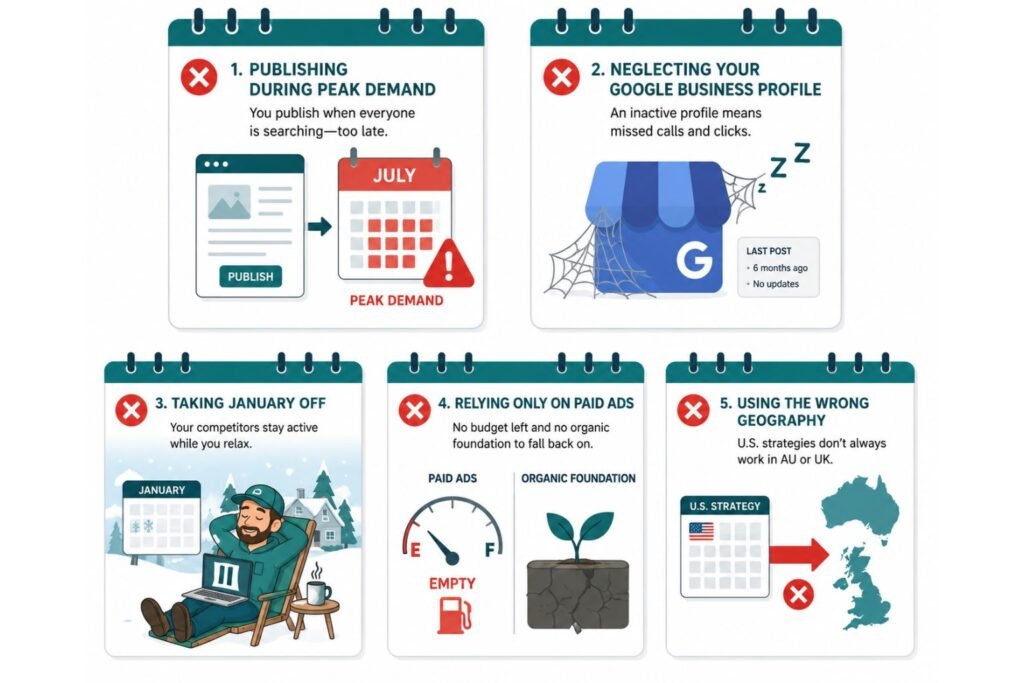
1. Publishing during peak season instead of before it. An “AC tune-up checklist” published in June will rank in August—after the season peaks and call volume starts declining. That content needed to go live in March. Every piece of seasonal content should have a hard publish deadline 90 days before peak demand, scheduled in advance, not written when inspiration hits.
2. Leaving your GBP dormant during peak months. Three weeks without a GBP post in July actively depresses Local Pack rankings. A competitor posting weekly signals consistent, active business operations; a stale profile signals the opposite. Block 20 minutes every Monday during peak season and protect it the same way you’d protect a booked job.
3. Treating slow months as marketing breaks. January and February have no competitive pressure and carry the highest content ROI of the year. The pages published now will be indexed and ranking before the first high-volume month. The companies that go quiet in winter spend summer competing against pages with a four-month head start.
4. Running paid ads at peak without organic foundations underneath. Ads stop the second the budget pauses. Organic rankings don’t. The smart approach: use off-season months to build pages that compound over time, and let paid ads cover the gap while those pages build authority. After 12 to 18 months, you can trim the ad budget without a corresponding drop in calls.
5. Applying a US calendar to a non-US market. An Australian contractor publishing “get your AC ready for summer” content in April is targeting the wrong hemisphere. A UK contractor pushing boiler content in December missed the September–November peak by three months. Before you follow any calendar, run your primary keyword through Google Trends with your location set — historical search volume patterns will tell you exactly when your market moves.
How to Start Your Seasonal SEO Calendar in the Next 30 Days
You don’t need a full year of content to get started. You need the next 90 days, planned backwards.
Step 1: Identify the next seasonal peak. Open Google Trends and search your primary service keyword alongside your city name — the historical volume pattern shows exactly when your local market moves. Count back 90 days from the peak. That’s your content-live deadline. If you already have pages ranking, Google Search Console’s Performance report filtered by query will show you when those pages get impressions—that’s your actual seasonal curve, not a proxy. For tracking rank movement over time, see our HVAC local SEO tools guide.
Step 2: Audit what you have. AC repair, furnace repair, heat pump installation, emergency HVAC, and seasonal tune-up services each need a dedicated, optimized page. Check whether those exist. Existing pages that are thin or outdated can be expanded and republished—a meaningful update means adding depth: new sections, updated costs, real FAQs, or location-specific detail. That kind of substantive change re-triggers Google’s indexing process almost as effectively as a new page.
Step 3: Plan 2 to 4 pieces of content per month. Priority order: service page first, then location page, then diagnostic guide, then seasonal tips content. The reason for that sequence is intent: someone searching “AC repair [city]” is ready to call; someone searching “why is my AC blowing warm air” is diagnosing a problem and may call next. Service pages capture the bottom of that funnel. Diagnostic guides capture the top and build trust before the decision to hire.
Step 4: Build the GBP and review calendar alongside the content calendar. Block Monday mornings for GBP posts during peak season. Set up a review request that fires automatically after each job — your HVAC review strategy should align with your content calendar so review velocity peaks when rankings matter most.
Frequently Asked Questions
When should HVAC companies start publishing summer content?
By March 1. Google needs 60 to 90 days to index and rank new pages, which means cooling-season content published in March will be ranking by May — the start of peak demand. Content published in May will rank in July or August, after the bulk of the season has already passed.
How often should an HVAC company post on Google Business Profile?
Weekly during peak season — May through September for cooling, October through November for heating. In the off-season (December through April), biweekly is the minimum. Regular GBP posts expire after seven days, so weekly posts are what keeps the profile consistently current in Google’s eyes.
Does seasonal SEO work differently for HVAC than other home service businesses?
Substantially. Most service businesses see 20 to 30 percent seasonal variation in search demand. HVAC sees 300 to 500 percent. That extreme swing, combined with the emergency nature of most HVAC calls—homeowners who won’t wait an hour, let alone comparison shop—means timing precision matters far more than it does in almost any other service category. Missing the publish window by 30 days can cost an entire season’s worth of organic leads.
What HVAC keywords should I target in summer versus winter?
Cooling season (published by March): “AC repair near me,” “AC tune-up [city],” “central air installation cost,” “AC not cooling,” “emergency AC repair.” Heating season (published by August): “furnace repair near me,” “furnace tune-up [city],” “heat pump installation cost,” “furnace not working,” “emergency heating repair.” Emergency-intent variations — “not working,” “not cooling” — consistently drive the highest call volume because they match the exact moment of crisis.
What should an HVAC company do for SEO during the off-season?
Build the next peak’s content, fix technical issues, run review collection from the previous peak’s jobs, update and expand location pages, and audit citation consistency. Off-season is when your competitors are quiet. It’s the highest-leverage window to build assets that outrank them once volume returns.
Is the HVAC seasonal SEO calendar different in Australia or the UK?
Yes. Australia’s calendar is flipped six months: cooling content arrives by September and heating content by March. In the UK, heating dominates year-round—boiler service content peaks September through November, so publish by June. Air conditioning in the UK is secondary but growing; publish by March for any May–July demand.
How long does it take for a new HVAC website page to rank?
Typically 60 to 90 days for a new page on an established domain, though it can stretch to four to six months on a newer or lower-authority site. This is why the seasonal deadlines in this calendar are non-negotiable — a furnace repair page published in October is unlikely to rank before winter demand peaks. An established page that’s been meaningfully updated tends to re-rank faster than a brand-new page, usually within 30 to 45 days.
When is the best time to run Google Ads for HVAC?
Paid ads are most efficient during peak months—May through August for cooling and October through November for heating—when search volume is high enough to generate meaningful volume at your budget. The trap is running ads as a substitute for organic rankings. Ads stop the moment budget pauses; organic pages don’t. The strongest approach is building organic foundations during off-peak months so that paid ads at peak are amplifying existing rankings rather than compensating for their absence.
What to Do Next
The company’s ranking in June started publishing in January. The ones ranking in November started in July. There’s no way around the indexing window, but there is a system, and this calendar is it.
Wherever you’re starting: find the seasonal peak that’s 90 days away and work from there. If it’s already within that window, publish what you have and accept a partial season—then start the next peak’s content immediately. Set the GBP schedule for the coming month. Get the review request automated. Then repeat it every quarter, always one season ahead.
If you want to see how the seasonal calendar connects to the full local SEO picture—citation building, service area architecture, and Google Business Profile setup—the HVAC local SEO guide covers the complete system. For how seasonal SEO fits alongside paid ads, email, and reputation management, start with the HVAC digital marketing guide.